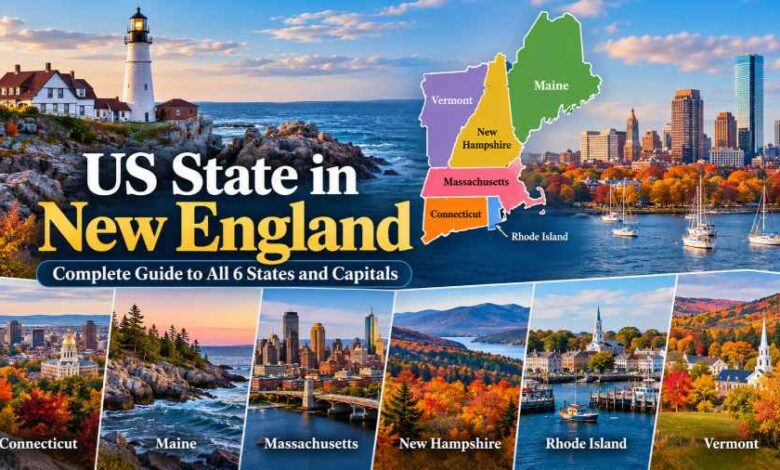
US State in New England is a geographical search term referring to the six states that make up the New England region in the northeastern United States. These states are Connecticut, Maine, Massachusetts, New Hampshire, Rhode Island, and Vermont. Each has its own capital, history, landscape, and cultural identity, while sharing a regional heritage shaped by early American settlement, maritime trade, education, and changing seasons. Understanding which states belong to New England helps students, travelers, researchers, and anyone studying US geography distinguish this historic region from other parts of the Northeast.
What Is New England in the United States?
New England is a recognized region in the northeastern United States, located along the Atlantic coast and extending inland toward the Appalachian Mountains and the Canadian border. According to the US Census Bureau’s regional classification, it consists of exactly six states. The region is part of the broader Northeast, but it is distinct from the Middle Atlantic division, which includes New York, New Jersey, and Pennsylvania. New England is known for its historic towns, coastal communities, mountain scenery, universities, and significant role in the development of the United States. Although its states share regional traditions, each maintains its own government, economy, and local character.
Which States Are in New England?
The six New England states are Connecticut, Maine, Massachusetts, New Hampshire, Rhode Island, and Vermont. They are often grouped together because of their geographic proximity, shared historical experiences, and cultural connections. However, they differ considerably in size, population, landscape, and economic activity. Massachusetts is especially associated with Boston and higher education, Maine with its rugged coastline and forests, and Vermont with its mountains and rural communities. Rhode Island is the smallest US state by area, while Connecticut combines historic towns with major metropolitan and suburban communities. These differences make the region more diverse than its shared name might suggest.
1. Connecticut: The Constitution State
Connecticut is located in the southern part of New England, between New York and Rhode Island, with Massachusetts along its northern border. Its capital is Hartford, while other important cities include New Haven, Bridgeport, and Stamford. The state combines coastal communities along Long Island Sound with wooded hills, historic villages, universities, and business centers. Connecticut is known for its insurance industry, manufacturing heritage, maritime attractions, and educational institutions. New Haven is home to Yale University, while Hartford has long been associated with the insurance sector. Visitors can explore Mystic’s maritime heritage, historic architecture, museums, and scenic river valleys. Connecticut became the fifth state to join the United States on January 9, 1788, and remains an important connection between the New England region and the wider northeastern metropolitan economy.
Capital and Major Attractions
Hartford serves as Connecticut’s political center and offers museums, historic buildings, and cultural attractions. New Haven is recognized for Yale University and its architectural and academic heritage, while Mystic attracts visitors interested in maritime history and coastal scenery. The Connecticut River Valley and Litchfield Hills offer outdoor recreation and rural landscapes, making the state suitable for travelers seeking both urban experiences and quieter countryside destinations.
2. Maine: The Pine Tree State
Maine occupies the northeasternmost part of the contiguous United States and is the largest New England state by land area. Its capital is Augusta, while Portland is its largest city and an important coastal destination. Maine is especially associated with rocky shorelines, fishing communities, forests, lakes, and outdoor recreation. Acadia National Park, located along the state’s Atlantic coast, is a major attraction for visitors interested in hiking, coastal views, and wildlife. The state’s maritime traditions have shaped local communities for generations, particularly through fishing and lobster harvesting. Maine became the 23rd state on March 15, 1820, after separating from Massachusetts. Its combination of coastal scenery and extensive inland wilderness gives it a distinctive identity within New England.
What Makes Maine Different?
Maine is a strong choice for travelers who prefer natural landscapes, small coastal towns, and outdoor activities. Portland offers restaurants, waterfront areas, and cultural attractions, while communities along the coast provide access to beaches, harbors, and island excursions. Inland areas feature forests, lakes, and opportunities for camping and hiking. Because distances between attractions can be substantial, visitors planning a road trip should account for travel time, seasonal conditions, and limited services in some rural areas.
3. Massachusetts: The Bay State
Massachusetts is one of the most prominent New England states because of its historical importance, educational institutions, and economic influence. Its capital and largest city is Boston, a major center for education, medicine, technology, finance, and culture. The state played a significant role in the American Revolution, with historic locations connected to the events that led to independence. Massachusetts became the sixth state to join the Union on February 6, 1788. Beyond Boston, the state includes university communities, coastal towns, agricultural areas, and the scenic Berkshire region in the west. Its mix of historical landmarks, modern industries, and cultural institutions makes it a major destination for domestic and international visitors.
Boston and the Wider State
Boston offers access to historic sites, museums, public parks, sports venues, and universities, including Harvard University in neighboring Cambridge and the Massachusetts Institute of Technology. The state’s attractions extend beyond the metropolitan area, with Cape Cod known for its beaches and coastal communities and the Berkshires associated with mountains, arts, and outdoor recreation. Massachusetts is also important to New England’s research and innovation economy, particularly in biotechnology, higher education, and healthcare.
4. New Hampshire: The Granite State
New Hampshire lies between Vermont and Maine, with Massachusetts to the south and the Canadian province of Quebec to the north. Its capital is Concord, and Manchester is its largest city. The state is known for the White Mountains, forested landscapes, lakes, and seasonal outdoor activities. Mount Washington, located in the White Mountains, is famous for its severe and rapidly changing weather conditions. New Hampshire’s economy includes manufacturing, healthcare, tourism, and services, while its towns preserve a strong connection to the region’s historical character. It became the ninth state to join the Union on June 21, 1788. The state’s combination of mountain scenery and accessible small cities makes it attractive to visitors throughout the year.
Mountains, Lakes, and Outdoor Recreation
The White Mountains are a major destination for hiking, scenic drives, and winter sports. The Lakes Region provides opportunities for boating and lakeside holidays, while towns such as Portsmouth offer historic architecture and a coastal atmosphere. Autumn is particularly popular because forests display changing foliage, although the timing and intensity vary with weather conditions. Winter visitors should prepare for snow, cold temperatures, and changing mountain conditions, especially when planning outdoor activities at higher elevations.
5. Rhode Island: The Ocean State
Rhode Island is the smallest US state by total area and sits in the southeastern part of New England. Despite its size, it has a distinctive maritime identity shaped by Narragansett Bay, coastal communities, islands, and historic ports. Providence is both its capital and largest city, offering universities, museums, restaurants, and a lively arts scene. Newport is famous for its waterfront, sailing traditions, historic mansions, and coastal attractions. Rhode Island became the 13th state on May 29, 1790, making it the last of the original thirteen colonies to ratify the US Constitution and join the Union. Its compact geography allows visitors to combine city experiences with coastal excursions without traveling across a large state.
Why Visit Rhode Island?
Rhode Island is particularly appealing to travelers interested in beaches, maritime heritage, architecture, and food. Newport’s historic estates illustrate the wealth and social history associated with America’s Gilded Age, while Providence offers cultural attractions and educational institutions. Coastal communities provide access to boating, swimming, and seaside walks during suitable weather. Although the state is small, travel times can still vary with traffic, especially during popular summer weekends and major local events.
6. Vermont: The Green Mountain State
Vermont is located in western New England, bordered by New York to the west, Massachusetts to the south, New Hampshire to the east, and Canada to the north. Its capital is Montpelier, while Burlington is its largest city. Vermont is widely associated with the Green Mountains, forests, rural villages, dairy farming, maple syrup, and outdoor recreation. The state attracts visitors who enjoy hiking, skiing, scenic drives, and traditional New England town centers. Vermont became the 14th state on March 4, 1791, after operating as an independent republic for several years. Its landscape and relatively small communities contribute to an identity that differs from the more urbanized parts of southern New England.
Scenic Towns and Seasonal Travel
Vermont is a popular destination during autumn, when forests change color, and during winter, when ski areas draw visitors to the mountains. Towns such as Stowe are associated with outdoor recreation, while Burlington offers a waterfront setting on Lake Champlain, restaurants, and cultural attractions. Visitors can also explore farms, local food producers, and historic villages. Rural travel may require more planning than trips to major cities because public transportation and services can be limited outside population centers.
New England States and Their Capitals
The capital cities of the six New England states are Hartford in Connecticut, Augusta in Maine, Boston in Massachusetts, Concord in New Hampshire, Providence in Rhode Island, and Montpelier in Vermont. A state capital is the city where the principal institutions of state government are located, including the legislature and governor’s office. A capital is not necessarily the state’s largest city or most famous destination. For example, Portland is Maine’s largest city, but Augusta is its capital; Burlington is Vermont’s largest city, but Montpelier is the capital. Understanding this distinction is useful for geography students, travelers, and readers comparing US state facts.
Where Is New England Located on the US Map?
New England occupies the northeastern corner of the United States, along the Atlantic Ocean. Maine forms the northeastern section of the region, while New Hampshire and Vermont lie farther inland along the Canadian border. Massachusetts occupies much of the central and southern portion, with Connecticut and Rhode Island toward the southwest and southeast. New York borders New England to the west, and Canada lies to the north. The region’s location has influenced its history, trade, transportation, and cultural development. Its coastline supported fishing, shipping, and port communities, while its rivers and mountains helped shape settlement and industry inland. Although New England is a commonly used regional name, the six-state grouping is also formally recognized by the US Census Bureau.
New England’s History and Cultural Importance
New England’s history includes Indigenous societies, European colonization, colonial trade, religious communities, and major events in the American Revolution. Indigenous peoples, including the Wampanoag, Abenaki, Narragansett, and many other nations, lived throughout the region long before European settlement. Colonization transformed the region’s communities and land use, bringing conflict, displacement, and lasting cultural change. During the eighteenth century, resistance to British policies helped make Massachusetts and other New England colonies important centers of revolutionary activity. After independence, the region developed industries connected to textiles, shipping, manufacturing, education, and commerce. Today, its historical identity remains visible in town centers, museums, preserved buildings, universities, and public commemorations, although the region’s modern communities are diverse and continue to evolve.
Climate and Best Time to Visit New England
New England experiences four distinct seasons, with conditions varying by location, elevation, and distance from the Atlantic coast. Spring generally brings milder temperatures and renewed greenery, while summer is popular for beaches, hiking, festivals, and outdoor exploration. Autumn attracts visitors hoping to see colorful foliage across forests and mountain landscapes. Winter brings snow and cold weather, particularly in northern areas and higher elevations, making the region suitable for skiing and other winter activities. Coastal southern areas can experience different conditions from inland mountain communities, so travelers should check local forecasts before departure. There is no single best season for every destination: the ideal time depends on whether the priority is coastal relaxation, mountain recreation, historical sightseeing, or seasonal scenery.
Economy, Education, and Everyday Life in New England
New England has a diverse economy that includes education, healthcare, technology, finance, manufacturing, tourism, agriculture, and maritime industries. Massachusetts is particularly prominent in research, biotechnology, and higher education, while Connecticut has established business and insurance sectors. Maine’s economy includes forestry, fishing, tourism, and other industries connected to natural resources. Vermont has strong agricultural and outdoor tourism traditions, while Rhode Island and New Hampshire combine services, manufacturing, and tourism with other regional industries. Universities and research institutions contribute to the region’s reputation for education and innovation. However, economic conditions and living costs vary considerably between metropolitan centers and rural communities. Anyone considering relocation should compare housing costs, employment opportunities, transportation, taxes, and access to services in the specific state and community rather than treating New England as a single uniform market.
How New England Differs From Other US Regions
New England is part of the Northeast, but the Northeast and New England are not interchangeable terms. The broader Northeast includes the six New England states as well as New York, New Jersey, and Pennsylvania under the US Census Bureau’s regional system. New England also differs from other US regions through its concentration of historic colonial settlements, Atlantic maritime communities, compact states, and long-established educational institutions. Its landscapes range from rocky coastlines and islands to forested hills, mountain ranges, and densely populated urban corridors. These characteristics help distinguish it from the Mid-Atlantic region, the Midwest, and the southern United States. Nevertheless, New England is not culturally or economically identical throughout: Boston’s metropolitan environment, Maine’s coastal communities, and Vermont’s rural towns offer noticeably different experiences.
Conclusion: US State in New England
The six states that make up New England are Connecticut, Maine, Massachusetts, New Hampshire, Rhode Island, and Vermont. Located in the northeastern United States, they share important historical connections while offering different landscapes, cities, industries, and cultural experiences. Knowing their capitals, geographic positions, and defining characteristics makes it easier to understand US regional geography, plan travel, and distinguish New England from the broader Northeast. From Boston’s historic and academic institutions to Maine’s coastline, New Hampshire’s mountains, Rhode Island’s maritime heritage, Vermont’s rural scenery, and Connecticut’s business centers, each state contributes something distinctive to the region. Together, they form one of America’s most recognizable geographical and historical regions.
Also read: What Is Acamento? Meaning, Origins, Uses, and Everything You Should Know
FAQs
1. How many states are in New England?
New England contains six states: Connecticut, Maine, Massachusetts, New Hampshire, Rhode Island, and Vermont, all located in the northeastern United States.
2. What is the capital of New England?
New England has no single regional capital because it is a region, not a state. Boston is its largest city and a major regional center.
3. Is New York part of New England?
No, New York is not part of New England. It belongs to the Middle Atlantic division of the Northeast region under the US Census Bureau classification.
4. Which New England state is the smallest?
Rhode Island is the smallest US state by total area. Despite its size, it features coastal communities, Narragansett Bay, and the historic city of Newport.
5. Which New England state is best known for fall foliage?
Vermont, New Hampshire, and Maine are especially popular for autumn foliage, although colorful fall landscapes can be found throughout all six New England states.
6. Which New England state has Boston as its capital?
Massachusetts has Boston as its capital and largest city. Boston is known for American history, universities, cultural attractions, healthcare, and technology.