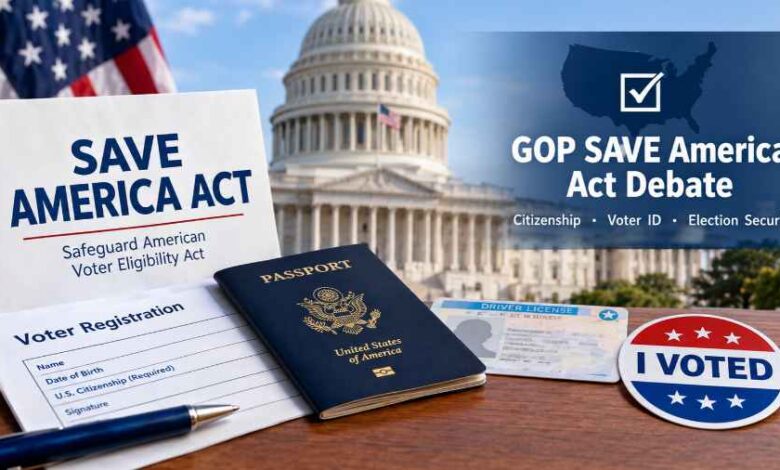
GOP SAVE America Act Debate has become a major issue in American election policy, raising questions about citizenship verification, voter identification, election security, and access to the ballot. The Republican-backed legislation seeks to introduce stricter requirements for registering to vote in federal elections, while Democrats and voting-rights advocates have raised concerns about the documents eligible citizens may need to provide. Understanding the debate requires looking beyond party politics to examine what the bill proposes, why supporters consider it necessary, why opponents challenge it, and what its progress through Congress means for American voters.
What Is the GOP SAVE America Act Debate?
The GOP SAVE America Act debate concerns the Safeguard American Voter Eligibility Act, a Republican-backed proposal designed to change federal voter-registration requirements. The legislation focuses on documentary proof of United States citizenship, photo identification for voting, and additional procedures for checking voter eligibility. Republicans supporting the measure argue that stronger verification requirements would reinforce confidence in federal elections and help ensure that only eligible citizens participate. Opponents question whether the proposed rules are necessary, given existing restrictions on noncitizen voting, and warn that documentation requirements could create additional barriers for eligible Americans. The controversy therefore involves both election administration and a broader disagreement about how to balance verification procedures with access to voting.
Background: How the SAVE America Act Developed
The current debate builds on earlier Republican efforts to change federal voter-registration rules. In 2024, a previous version of the SAVE Act passed the House but did not become law. Representative Chip Roy of Texas subsequently introduced another version in the 119th Congress, and the House passed that proposal in April 2025. The SAVE America Act introduced in 2026 broadened the debate by combining citizenship-documentation requirements with photo identification provisions for federal elections. The distinction matters because the names and legislative texts are similar, but the proposals are not identical. The 2026 measure should therefore be evaluated using its own provisions and congressional history rather than treating every version as the same bill.
What Would the SAVE America Act Require?
The proposed legislation would change how states register eligible voters for federal elections and establish additional identification requirements. Its practical impact would depend on the final legislative text, implementation guidance, state election procedures, and any subsequent court decisions.
Documentary Proof of U.S. Citizenship
The central provision would require applicants to provide documentary evidence of U.S. citizenship when registering to vote in federal elections. Examples of qualifying documents under the proposed framework include a valid U.S. passport, certain government-issued identification showing citizenship or U.S. birth, and specified combinations of identification with a birth certificate or naturalization documentation. These requirements go beyond simply checking a box or signing a declaration of citizenship on a registration application. States would also need procedures for evaluating alternative evidence when applicants cannot provide the standard documents or when their records contain discrepancies.
Photo Identification for Federal Elections
The legislation would also establish photo identification requirements for voting in federal elections. The proposed framework identifies categories of acceptable identification, including qualifying state-issued driver’s licenses, nondriver identification cards, passports, military identification, and certain tribal identification documents. These provisions would make it important for voters to understand which documents qualify and whether the information on their identification matches their registration records. Citizenship documentation and photo voter identification are related but distinct issues: proof of citizenship concerns eligibility to register, while photo identification concerns verification under the voting rules.
Additional Voter-Roll Verification
Another part of the proposal concerns how election officials verify citizenship and maintain voter-registration records. The legislation would require states to take additional steps to identify people who are not eligible to register for federal elections and to address records indicating that a registered person is not a citizen. Supporters argue that systematic checks could strengthen election administration. However, implementing those checks requires reliable information, clear procedures, and safeguards against mistakenly flagging eligible citizens. A record discrepancy or outdated database entry is not necessarily proof that a person is ineligible, so the accuracy of verification systems and the opportunity to correct errors are important considerations.
Why Republicans Support the SAVE America Act
Republican supporters present the proposal as an election-integrity measure intended to strengthen confidence in federal elections. Their argument is that citizenship is a basic requirement for voting in federal contests and that documentary verification would provide an additional safeguard against ineligible registration. Supporters also argue that photo identification requirements could establish consistent procedures for confirming voter identity. President Donald Trump and Republican lawmakers have made the legislation part of a broader debate over election administration and federal election standards. From this perspective, the proposed changes would make eligibility checks more explicit and establish clearer responsibilities for state election officials. Whether the new requirements would produce substantial additional benefits is a separate empirical question that depends on existing safeguards, implementation costs, and the frequency of the problems the bill seeks to address.
Election Security and Public Confidence
Supporters argue that election systems need both effective safeguards and public confidence. They believe documentary citizenship checks could make it easier to demonstrate that federal voter-registration procedures enforce eligibility rules. In their view, standardized requirements could also reduce differences between states and establish a clearer framework for checking registration applications. However, confidence in election systems can be influenced by many factors, including transparent procedures, accurate voter rolls, secure ballot handling, accessible registration, and public understanding of election rules. The effect of a new documentation requirement should therefore be assessed alongside existing protections rather than assumed from the policy’s stated objective alone.
Consistent Standards Across States
Another argument in favor of the proposal is that federal elections should follow consistent eligibility safeguards even though states administer their own registration systems. Current registration procedures differ across jurisdictions, including how states process applications, maintain voter lists, and verify information. Supporters see a federal documentary-proof requirement as a way to establish a common baseline. Opponents counter that states have different administrative systems and populations, so a uniform rule may create complications where records are incomplete or government documents are difficult to obtain. The practical question is whether a common federal standard can be implemented accurately without imposing disproportionate burdens on eligible voters.
Why Democrats and Voting-Rights Groups Oppose the Bill
Democratic lawmakers and voting-rights organizations have raised concerns about access to the ballot, administrative complexity, privacy, and the potential for eligible citizens to encounter registration difficulties. Their central objection is not that noncitizens should be permitted to vote in federal elections. Federal law already prohibits noncitizens from voting in federal contests. Instead, critics question whether the proposed documentary requirements are necessary and whether they could prevent eligible citizens from registering because they lack the specific records required. They also argue that election officials must have practical ways to verify citizenship without unnecessarily excluding people whose eligibility is legitimate but whose paperwork is incomplete. These concerns make the debate about the design and consequences of the rules, as well as the objective of enforcing voter eligibility.
Barriers for Eligible Citizens
Some American citizens do not have immediate access to a passport, birth certificate, or other qualifying citizenship records. Documents may be lost, contain errors, or be difficult to obtain because of administrative delays, changes in personal information, or differences in recordkeeping. A citizen born outside a hospital, for example, may face different documentation challenges from someone whose birth was promptly registered and whose records have remained consistent. Critics warn that a documentary-proof requirement could require some eligible citizens to spend time and money obtaining replacement records before they can register. The extent of the impact would depend on the final rules, the availability of alternative verification procedures, and how efficiently states help applicants resolve documentation problems.
Concerns About Older Voters and Name Changes
People who have changed their names through marriage or other legal processes may have records that do not match exactly. Older Americans may have difficulty obtaining historical birth records, while naturalized citizens may need to locate citizenship documents issued many years earlier. Military families, rural residents, and people who have moved between states could also encounter administrative complications when documents or records are held by different authorities. These circumstances do not automatically make someone ineligible to vote, but they illustrate why verification procedures need reliable alternatives and timely appeals. Critics argue that the law’s real-world effect would depend heavily on how election officials handle these cases rather than only on the wording of the eligibility rule.
Privacy and Government Data Concerns
The proposal also raises questions about how states would obtain and use information to verify citizenship. Effective verification may require coordination among election offices and other government agencies, creating questions about data accuracy, access, retention, and permitted uses. Supporters see information sharing as a way to identify ineligible registrations more effectively. Critics warn that inaccurate or mismatched records could trigger unnecessary investigations or affect eligible citizens. Clear rules about data security, error correction, oversight, and the use of personal information would therefore be important to implementation. These issues are distinct from whether citizenship should be a requirement for voting, which is already established under federal law.
Is Noncitizen Voting Already Illegal in the United States?
Yes. Noncitizens generally cannot vote in federal elections under existing federal law, and knowingly violating applicable voting laws can carry legal consequences. Some local jurisdictions permit certain noncitizens to vote in particular local elections under local rules, but that is different from voting in federal contests. The SAVE America Act debate is therefore not about introducing the citizenship requirement for the first time. It concerns whether federal registration procedures should require documentary evidence to establish citizenship and whether additional verification and identification rules should apply. This distinction is essential to understanding competing arguments: supporters emphasize stronger preventive checks, while critics emphasize the limited evidence of noncitizen voting in federal elections and the potential consequences of imposing new documentation requirements on eligible citizens.
What Happened to the SAVE America Act in Congress?
The legislative path of the 2026 SAVE America Act has involved House passage, Senate procedural disputes, and unsuccessful efforts to advance the proposal through alternative legislative routes. The House approved the measure on February 11, 2026, by a vote of 218–213. The bill then faced a more difficult path in the Senate, where the rules governing debate and consideration created obstacles to advancing it. During March, senators considered motions and amendments connected to the legislation, but those procedural steps did not produce enactment. Later efforts to incorporate the proposal into broader legislation also encountered resistance. By August 2026, the bill remained stalled as the Senate recessed, and the available legislative record did not show it becoming federal law.
The House Vote in February 2026
The House vote on February 11 was 218 in favor and 213 against. Only one Democrat joined Republicans in supporting the measure, reflecting the sharp partisan division surrounding the proposal. House passage meant the chamber approved the bill’s text; it did not mean the legislation had completed the full congressional process. The measure still faced Senate consideration and the possibility of further amendments, procedural challenges, or changes to its provisions. This distinction is important when reading political headlines because a House vote, a vote to begin debate, and final passage by Congress are different legislative events.
Why the Senate Became a Major Obstacle
The Senate’s procedural rules have been central to the debate. Many major pieces of legislation require 60 votes to end debate and overcome a filibuster, although the exact procedure and applicable exceptions depend on the motion and circumstances. Republicans did not have enough support to ensure that the measure could clear every procedural hurdle under the ordinary process. Senate votes and negotiations over amendments showed that securing a majority for a proposal is not always sufficient to move it through the chamber. As a result, the SAVE America Act became a test of both party priorities and the limits of the legislative procedures available to its supporters.
Attempts to Use Other Legislative Routes
Supporters also explored ways to attach or incorporate the measure into other legislation. Such approaches can change the procedural requirements and political negotiations surrounding a bill, but they do not guarantee passage. In June 2026, an effort to incorporate the SAVE America Act into a budget reconciliation bill was blocked. The proposal remained unresolved as the Senate recessed in August. These developments illustrate why legislative status should be tracked through official congressional records rather than inferred from public statements, campaign messaging, or the introduction of a new bill number. A proposed amendment, procedural motion, or announced strategy is not equivalent to a law taking effect.
How Could the Bill Affect American Voters?
The practical effects of the SAVE America Act would depend on whether it became law, the implementation timeline, and the administrative systems states used to comply. If enacted, the requirements could change the process for first-time registrants, people updating their registration, and citizens whose records do not readily establish eligibility. Some voters might already possess qualifying documents and experience little change, while others could need to request records, correct discrepancies, or complete additional verification steps. Election administrators would also need to communicate the new rules, train staff, update registration systems, and establish procedures for disputed cases. These potential effects should be distinguished from actual changes in voting access, because a proposal that has not become law does not itself impose new requirements on voters.
First-Time Voter Registration
First-time registrants could be among the people most directly affected by a documentary-proof requirement. Under the proposed framework, applicants would need to provide an acceptable citizenship document or use an applicable alternative verification procedure rather than rely solely on the existing registration process. This could make preparation more important, particularly for people who register close to a deadline or apply through a process that ordinarily requires little paperwork. States would need to explain acceptable documents clearly and provide accurate guidance about alternative evidence. Until a measure is enacted and its effective date is established, however, voters should follow the rules currently in force in their own state rather than assume the proposed requirements already apply.
State Election Administrators
State and local election officials would face significant implementation responsibilities if the legislation became law. These could include revising forms, adapting electronic registration systems, coordinating with other agencies, training staff, reviewing documentation, and providing procedures for applicants whose records do not match. Officials would also need to handle questions from voters and ensure that eligible applicants understand how to resolve problems. The costs and complexity would vary by state because existing systems and recordkeeping practices differ. An effective implementation plan would need to balance accurate verification with timely registration processing and consistent treatment of eligible applicants.
Implications for the 2026 Midterm Elections
The debate has particular significance because the 2026 midterm elections will determine control of Congress and influence the political agenda for the remainder of the current congressional term. However, the existence of a proposed federal election bill does not mean its provisions automatically govern those elections. The timing of enactment, effective-date language, implementation requirements, and possible legal challenges would all matter. With the proposal stalled in the Senate as of August 2026, voters should distinguish between the political debate surrounding election rules and the laws actually governing their registration and ballots. For accurate practical guidance, state election offices remain an important source of current registration requirements and deadlines.
The Legal and Constitutional Questions Behind the Debate
The SAVE America Act raises questions about the relationship between federal election standards and state responsibility for administering elections. The Constitution gives states significant authority over the times, places, and manner of congressional elections while also allowing Congress to regulate those elections within its constitutional powers. The proposed legislation would use federal law to establish additional registration and identification requirements. If enacted, its provisions could face legal challenges involving federal authority, existing election statutes, administrative burdens, and the treatment of eligible voters. The outcome of any challenge would depend on the specific legal arguments, evidence, statutory language, and court rulings. It would be premature to present a disputed constitutional interpretation as a settled judicial conclusion.
Federal Authority and State Election Rules
Federal elections are administered through a combination of federal law and state procedures. Existing federal statutes establish requirements for voter registration and prohibit noncitizens from voting in federal elections, while states manage many practical details of registration and election administration. Supporters of the SAVE America Act argue that Congress can establish additional federal safeguards for federal elections. Opponents may challenge specific requirements or their implementation based on statutory and constitutional grounds. Understanding this division of authority helps explain why the bill could affect state election offices even though its primary focus is federal elections. It also explains why any final law would need to be read alongside existing federal and state requirements.
Potential Litigation and Implementation Disputes
If enacted, the measure could prompt disputes about how its requirements should be interpreted and implemented. Questions might concern which documents qualify, how alternative evidence should be assessed, how agencies share information, and what remedies are available when eligible citizens face registration problems. Courts could also be asked to consider whether particular provisions conflict with existing legal protections or exceed federal authority. The outcome cannot be assumed in advance. A careful assessment would distinguish the legislation’s actual text from allegations made in lawsuits, arguments advanced by advocacy groups, and decisions that courts have formally issued.
What Happens Next in the SAVE America Act Debate?
The next stage depends on congressional action, negotiations over legislative strategy, and whether supporters attempt another route to passage. A bill that remains stalled can still be discussed, revised, or attached to another proposal, but each route has its own procedural requirements and political obstacles. The relevant questions are whether congressional leaders schedule further consideration, whether sufficient votes emerge to overcome procedural barriers, and whether any revised version changes the original proposal. Official House and Senate records provide the clearest way to distinguish a new procedural step from actual enactment. Until Congress passes the relevant legislation and it becomes law, the proposed requirements should not be described as nationwide rules already in force.
What Voters Should Watch
Voters following the issue should pay attention to official bill-status updates, recorded congressional votes, the text of any amendments, and announcements from state election administrators. These sources can clarify whether lawmakers are considering the original bill, a revised proposal, or a related measure with different provisions. It is also important to check the date of news reports, because a headline describing a planned vote may no longer reflect the current status. Anyone preparing to register should use the existing official guidance for their state instead of relying on political commentary about what a proposed bill might require in the future.
How to Evaluate Claims From Both Parties
The debate is politically charged, so readers benefit from separating verifiable facts from predictions and advocacy. The House vote count, the text of a bill, and a Senate procedural result can be checked against official records. Claims that a policy will eliminate fraud, suppress eligible voters, save money, or transform public confidence require additional evidence and should not be treated as established simply because a political figure makes them. A balanced evaluation considers both the intended safeguards and the possible administrative consequences, including the reliability of citizenship records, the availability of alternative verification, and the number of eligible voters who might face additional hurdles. This approach allows readers to understand the disagreement without assuming that every claim from either side has equal evidentiary support.
Conclusion
The GOP SAVE America Act debate reflects a fundamental disagreement over how the United States should verify eligibility for federal elections while preserving access for eligible citizens. Supporters emphasize documentary proof of citizenship, photo identification, and stronger voter-registration checks, while opponents question the necessity of additional requirements and warn about administrative burdens, privacy concerns, and potential barriers to voting. The House passed the measure in February 2026, but Senate procedural obstacles and unsuccessful efforts to advance it through alternative routes left it stalled as of August. Its future depends on further congressional action and any subsequent legal developments. For readers, the key is to distinguish the bill’s proposed requirements from current law and to evaluate claims using reliable evidence rather than partisan assertions.
Also read: HMJones.net: Essential Facts About the Business Finance Website
FAQs
1. What does the SAVE America Act stand for?
SAVE America Act stands for Safeguard American Voter Eligibility Act, a Republican-backed proposal addressing citizenship verification, voter identification, and federal election registration procedures.
2. Did the House pass the SAVE America Act in 2026?
Yes. The House passed the SAVE America Act on February 11, 2026, by 218–213, but House passage alone did not make it law.
3. Does the SAVE America Act require proof of citizenship to register?
The proposal would require documentary proof of U.S. citizenship for federal voter registration, with provisions for alternative evidence when applicants cannot provide standard qualifying documents.
4. Why do Democrats oppose the SAVE America Act?
Democrats and voting-rights advocates argue that documentation requirements could complicate registration for eligible citizens, increase administrative burdens, and create privacy concerns involving government records.
5. Is the SAVE America Act currently federal law?
As of the latest verified legislative developments available for this article, the proposal remained stalled in the Senate and had not become federal law.
6. How could the SAVE America Act affect the 2026 midterm elections?
Its impact would depend on enactment and implementation timing. Until then, voters should follow existing state registration requirements and official election guidance.