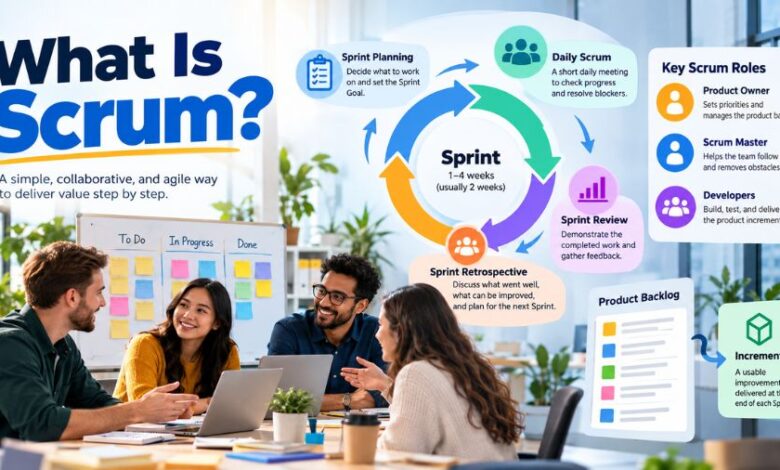
Scrum is a popular framework that helps teams organize complex projects, collaborate effectively, and deliver valuable results through short, structured work cycles. It is widely used in software development, product management, and other environments where requirements can change as a project progresses. Understanding what Scrum is can help beginners, project managers, software engineers, and business owners improve their approach to planning and delivering work. Instead of attempting to complete an entire project before receiving feedback, Scrum encourages teams to develop smaller improvements, review their results, and learn from experience. This approach makes it easier to identify problems early, adjust priorities, and maintain a shared understanding of project goals. Although Scrum is often associated with Agile software development, it is a framework rather than a programming language, software tool, or rigid project management procedure. Its effectiveness depends on teamwork, transparency, regular inspection, and continuous improvement.
What Is Scrum?
Scrum is a lightweight framework designed to help people and teams generate value through adaptive solutions to complex problems. It provides a structured way to organize responsibilities, manage work, and evaluate progress without prescribing every detail of how tasks must be completed. A Scrum team works toward a shared objective and divides its activities into time-limited periods called Sprints. During each Sprint, team members focus on producing a usable improvement that contributes to the overall product. They inspect the results, consider feedback, and use what they learn to guide future decisions. For example, a team developing an online shopping platform might begin by creating a product catalog, then improve the shopping cart, and later introduce payment functionality. Each improvement can be evaluated before the team commits to further development. Scrum therefore combines clear goals with flexibility, allowing teams to respond to new information without losing sight of the product’s purpose.
How Does the Scrum Framework Work?
The Scrum framework works through a repeating cycle of planning, development, evaluation, and improvement. At the beginning of a Sprint, the team establishes a Sprint Goal and selects appropriate work from the Product Backlog. Developers then create a plan for completing that work while maintaining the quality standards required for the product. Throughout the Sprint, they coordinate their activities, discuss progress, and adapt their plan when necessary. The Daily Scrum helps Developers inspect progress toward the Sprint Goal and identify adjustments to their work. At the end of the Sprint, the team reviews the resulting product increment and discusses possible improvements to its working practices. Sprints last one month or less, with many teams choosing a shorter duration that supports frequent feedback. This repeated process makes project progress easier to evaluate and allows teams to respond to changing business needs. However, Scrum does not automatically guarantee success; teams still need realistic goals, appropriate skills, effective communication, and disciplined execution.
The Main Roles and Responsibilities in Scrum
Scrum defines three accountabilities within one Scrum Team: the Product Owner, the Scrum Master, and the Developers. The Product Owner is accountable for maximizing product value and managing the Product Backlog effectively. This involves communicating product goals, making priorities clear, and ensuring that important work is understood. The Scrum Master is accountable for establishing Scrum as defined by its framework and helping the team and organization improve their effectiveness. This person supports collaboration, facilitates learning, and helps address obstacles that interfere with progress. Developers are the people committed to creating a usable product increment during each Sprint. Their work may include programming, testing, design, analysis, documentation, and other activities needed to deliver a complete improvement. These accountabilities are complementary rather than competing positions. A Product Owner does not simply assign every task, a Scrum Master is not merely a traditional project supervisor, and Developers collectively manage their work. Clear accountability helps the team make informed decisions while remaining focused on a common product objective.
Understanding Scrum Sprints
A Sprint is a fixed-length period during which a Scrum Team works toward a specific objective and produces a valuable product increment. Every Sprint contains the activities needed to plan, develop, inspect, and improve the team’s work. Sprint duration remains consistent to establish a predictable rhythm and make progress easier to evaluate. For instance, a software team might use two-week Sprints to introduce improvements to a customer dashboard. During the first few days, Developers may implement the interface and supporting API. They can then test the functionality, correct defects, and integrate the changes into the existing application. The team should aim to meet its Definition of Done rather than treating unfinished work as completed simply because the Sprint has ended. A Sprint can be cancelled only when its Sprint Goal becomes obsolete, and the Product Owner has the authority to make that decision. Well-planned Sprints provide a balance between focused execution and adaptability, helping teams deliver improvements without committing to an inflexible long-term plan.
Scrum Events and Their Purpose
Scrum includes five formal events: the Sprint, Sprint Planning, the Daily Scrum, the Sprint Review, and the Sprint Retrospective. The Sprint provides the overall container for the other events and activities. Sprint Planning establishes why the Sprint is valuable, what can be accomplished, and how the work will be approached. The Daily Scrum is a short event for Developers to inspect progress toward the Sprint Goal and adjust their plan. It is not intended to become a lengthy status report to management. The Sprint Review allows the Scrum Team and stakeholders to inspect the outcome and discuss future adaptations based on new information. The Sprint Retrospective focuses on improving quality, collaboration, and effectiveness by examining how the previous Sprint went. Each event serves a different purpose, but together they create a continuous learning cycle. When teams use these events effectively, they can identify risks earlier, understand stakeholder expectations, and improve their working methods without relying exclusively on end-of-project evaluations.
What Is a Product Backlog in Scrum?
The Product Backlog is an ordered, evolving list of work needed to improve a product. It may include new features, technical improvements, defects, research activities, and other changes that contribute to the product’s goals. The Product Owner is accountable for effective Product Backlog management, including making items understandable and ensuring that priorities reflect product needs. For example, an online learning platform might have backlog items for student registration, course search, video playback, subscription payments, and accessibility improvements. The order of these items can change when customer feedback, business priorities, or technical discoveries reveal new opportunities. Before Sprint Planning, the team may refine backlog items to improve their clarity, size, and readiness for discussion. A Product Backlog is not necessarily a permanent list of everything that will ever be built. It evolves as the team learns more about users and the market. This adaptability helps prevent teams from spending excessive time developing features that no longer provide sufficient value.
What Is a Sprint Backlog?
The Sprint Backlog contains the Sprint Goal, the Product Backlog items selected for the Sprint, and the actionable plan for delivering the intended outcome. It belongs to the Developers, who use it to organize their work and adapt their approach throughout the Sprint. During Sprint Planning, Developers consider their capacity, the complexity of the work, and the progress they expect to make. They then create a practical plan rather than accepting an unrealistic collection of tasks simply to satisfy external expectations. For example, a team working on authentication might select tasks involving login functionality, password validation, automated testing, and error handling. If new information emerges, Developers can update the Sprint Backlog while continuing to protect the Sprint Goal. The Sprint Backlog is therefore more than a checklist of assigned tasks. It is a working plan that helps the team understand what it is trying to achieve, what remains to be done, and how its approach should change as work progresses.
Benefits of Using Scrum
Scrum offers several potential benefits when it is implemented with a clear purpose and supported by an effective team. Frequent delivery creates opportunities to receive feedback before too much time or money is invested in a particular direction. Regular inspection can help teams identify defects, misunderstandings, and technical risks earlier than approaches that postpone evaluation until the end of a project. Defined accountabilities improve clarity about product priorities, team effectiveness, and delivery responsibilities. Short Sprints also make it easier to review progress and revise plans when business conditions change. For software teams, Scrum can support closer collaboration between Developers, product stakeholders, and people responsible for testing and design. It can also encourage continuous improvement by giving teams dedicated time to reflect on their processes. Nevertheless, these benefits are not automatic. Excessive meetings, unclear product goals, frequent interruptions, and unrealistic commitments can undermine Scrum. Teams achieve better results when they treat the framework as a way to improve collaboration and learning rather than simply adopting its terminology.
Scrum vs. Agile: Understanding the Difference
Agile and Scrum are closely related, but they are not interchangeable terms. Agile describes a set of values and principles that emphasize adaptability, collaboration, customer feedback, and delivering useful results. Scrum is a specific framework that supports an empirical and iterative approach to complex work. In simple terms, Agile describes a broader philosophy, while Scrum provides a defined structure for applying compatible principles. Other approaches, such as Kanban and Extreme Programming, also support aspects of Agile thinking through different practices and methods. A Scrum Team may use additional engineering techniques, including automated testing, continuous integration, and code reviews, to improve product quality. Organizations should therefore avoid assuming that adopting Scrum automatically makes every aspect of their development process Agile. Effective implementation requires a willingness to respond to feedback, maintain quality, and adapt decisions based on evidence. Understanding the distinction helps teams choose suitable practices instead of treating Scrum, Agile, and individual project management tools as if they all meant the same thing.
Common Scrum Mistakes Beginners Should Avoid
Teams new to Scrum sometimes focus on following a schedule of meetings without understanding the purpose behind each event. Another common mistake is treating the Daily Scrum as a manager-led interrogation rather than an opportunity for Developers to coordinate their work. Unrealistic Sprint commitments can create unnecessary pressure and encourage shortcuts that damage quality. Teams may also select too many unrelated priorities, leaving them busy without making meaningful progress toward a shared goal. Other problems include maintaining an outdated Product Backlog, ignoring stakeholder feedback, and carrying unfinished work forward without understanding why it was not completed. Scrum can become less effective when the Scrum Master is treated only as a meeting organizer or when the Product Owner cannot make clear prioritization decisions. Beginners should focus on establishing a meaningful Sprint Goal, maintaining transparency, respecting the Definition of Done, and discussing problems honestly. Small, evidence-based improvements are generally more sustainable than attempting to change every process at once.
How to Start Using Scrum in a Real Project
A practical way to introduce Scrum is to begin with a product goal that explains the value the team wants to create. Establish a Scrum Team with the necessary skills and make the Product Owner, Scrum Master, and Developers’ accountabilities clear. Next, create an initial Product Backlog containing the most important features, improvements, and known problems. Choose a manageable Sprint duration and use Sprint Planning to agree on a realistic goal and an actionable plan. During the Sprint, Developers should collaborate closely, maintain quality, and use the Daily Scrum to adapt their approach. At the end, inspect the product increment with stakeholders and identify opportunities to improve the team’s working methods during the Retrospective. A physical board or digital project management tool can make work visible, but the tool itself does not make a process Scrum. Teams should also monitor useful indicators, such as product quality, customer feedback, and the reliability of delivery, without using individual productivity metrics to encourage unhealthy competition. Starting simply allows the team to learn what works and refine its approach over time.
Also read: Neworldsmagazine.com: A Complete Guide to Its Content and Features
Conclusion
Scrum is a lightweight framework that helps teams manage complex work through clear goals, short Sprints, frequent feedback, and continuous improvement. Its main elements include the Product Owner, Scrum Master, and Developers, supported by the Product Backlog, Sprint Backlog, Sprint Goal, and five formal events. When these elements work together, teams can make progress visible, identify problems earlier, and adapt their plans as they learn more about customer needs. Scrum is especially useful when requirements evolve and regular evaluation can improve the final result. However, success depends on more than holding meetings or using a particular project management tool. Teams need collaboration, realistic commitments, technical quality, and a genuine willingness to learn from outcomes. For beginners, the best starting point is to understand the purpose of the framework and apply its principles consistently. With practice and thoughtful improvement, Scrum can help organizations deliver valuable products while building more transparent, adaptable, and effective teams.