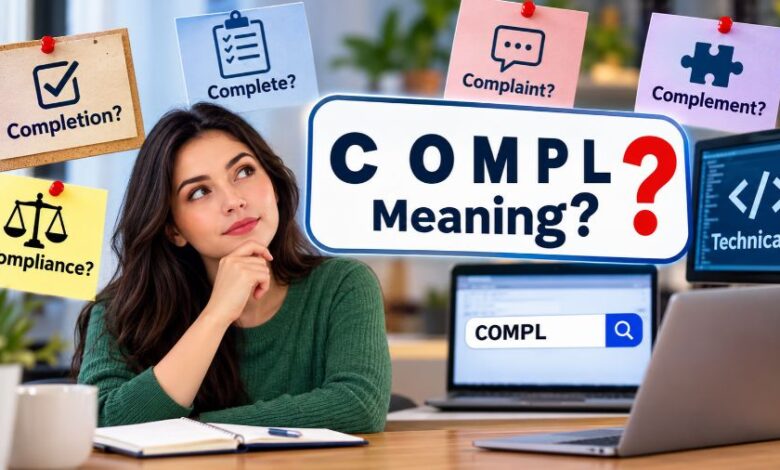
The term “c o m p l” may look like a simple collection of letters, but its meaning can vary depending on where it appears and how it is used. People may encounter COMPL in online searches, digital messages, business documents, technical discussions, forms, or abbreviations. Unlike familiar English words with established definitions, this combination does not have one universally recognized meaning in every situation. Understanding it requires examining the surrounding text, the subject being discussed, and the purpose for which the term appears. This guide explores possible interpretations, common abbreviation patterns, and practical ways to identify the intended meaning of COMPL.
What Is COMPL?
COMPL is a short letter combination that may function as an abbreviation, an internal code, or a shortened form of a longer word. Its interpretation depends on the environment in which it is used. For example, someone reading a workplace document might encounter a shortened label that makes sense only within that organization. A person searching online might instead be looking for a general definition or a particular company, service, or technical term. Therefore, it is important not to assume that every appearance of COMPL refers to the same thing. Identifying its original context is the first step toward understanding it correctly.
Possible Meanings of the Term COMPL
Several words begin with the letters “compl,” which makes the combination potentially useful as a shortened form. Depending on the context, it might be associated with completion, complete, compliance, complement, or complaint. However, these are possibilities rather than universal definitions of COMPL. The intended expansion cannot be established from the letters alone. For instance, a workplace checklist might use a similar abbreviation to indicate that a task has been completed, while a customer service record might use a different internal code. The surrounding information is essential for determining which interpretation, if any, is appropriate.
COMPL as an Abbreviation in Everyday Communication
Abbreviations are common in everyday communication because they help people express information quickly. Text messages, workplace chats, handwritten notes, and digital forms often use shortened words to save space or reduce typing. COMPL could appear in such environments as an informal abbreviation, particularly when the people communicating already understand its meaning. However, abbreviations can create confusion when readers are unfamiliar with them. A short label that is perfectly understandable to one team may be unclear to another. When clarity matters, writing the complete word the first time and introducing the abbreviation afterward is usually a better approach.
Understanding COMPL in Technical Environments
Technical environments frequently use abbreviations to represent functions, commands, categories, or internal system labels. Software developers, engineers, administrators, and other professionals may work with shortened terms that have specific meanings within their projects. In programming, for example, the word “complement” can describe an operation that produces the opposite of a value under a defined representation. Nevertheless, COMPL should not automatically be treated as a standard programming command or universal technical keyword. Its meaning must be checked against the relevant programming language, software documentation, or system specification before someone uses it in code or technical instructions.
COMPL in Business and Workplace Documents
Business documents often contain abbreviated labels because employees need to record information efficiently. A spreadsheet, project tracker, invoice, internal report, or operational checklist might contain a short code whose definition is specific to the organization. In one workplace, a similar abbreviation could relate to task completion; in another, it could identify a compliance category or customer complaint. The same letters may therefore communicate different information across departments. Anyone reviewing a business document should examine the column headings, nearby entries, document purpose, and any abbreviation guide provided by the organization before interpreting COMPL or making decisions based on it.
Why Context Matters When Interpreting COMPL
Context is the most reliable starting point when a short term has multiple possible meanings. Consider three situations: COMPL appears beside a task status, within a technical manual, or in a customer support record. Each environment suggests a different type of information, but none proves a particular definition by itself. The reader should look at the words surrounding the abbreviation, the information being recorded, and the conventions used in that setting. If the meaning remains uncertain, asking the author or checking the relevant documentation is more reliable than choosing the first possible expansion found in a general search.
How to Find the Correct Meaning of COMPL
Finding the correct meaning begins with preserving the exact spelling and identifying where the term appeared. Determine whether it was written as COMPL, compl., or “c o m p l,” because spacing, punctuation, and capitalization may provide useful clues. Next, identify the source: a website, application, company document, technical interface, or personal message. Search for the term together with a relevant phrase from its original environment. For example, adding a document category or software name can narrow the results. If several interpretations remain possible, compare them with the original context rather than relying on a definition that merely sounds plausible.
Examples of How Similar Abbreviations May Be Used
Similar abbreviations illustrate why careful interpretation matters. A project tracker might display a shortened label associated with completion, while a customer service platform could use a code associated with complaints. A technical document might use a shortened form of a specialized term, and a company database could assign the same letters to an entirely internal category. These examples demonstrate possible abbreviation patterns, not confirmed definitions of COMPL. Readers should distinguish between an illustrative example and an established meaning. That distinction prevents misunderstandings, especially when the abbreviation appears in instructions, official records, technical procedures, or other documents where accuracy is important.
Common Mistakes When Searching for COMPL
One common mistake is assuming that a short abbreviation has only one meaning. Another is treating an informal interpretation as an official definition without checking the original source. Search results can also create confusion when they combine unrelated subjects, similar spellings, company names, and technical terminology. A third mistake is overlooking punctuation or the surrounding sentence, which may contain the information needed to understand the term. To avoid these problems, compare multiple relevant explanations, prioritize documentation from the organization or system where the abbreviation appeared, and clearly separate verified information from possibilities. This approach produces a more accurate interpretation.
COMPL and Online Search Intent
People searching for COMPL may have different goals. Some want a quick definition, others need help understanding a message, and some may be looking for a particular product, organization, or technical concept. A useful informational explanation should address these different possibilities without presenting speculation as fact. For website owners and content creators, this makes the keyword challenging because its search intent is not immediately clear. Helpful content should explain the ambiguity, describe how abbreviations work, and guide readers toward the correct interpretation. More specific information about the source or subject can then support a focused article that better matches the searcher’s actual needs.
How to Write About COMPL Accurately
Writing about an ambiguous keyword requires a balance between useful explanation and factual accuracy. Start by identifying what is known, then explain which interpretations remain uncertain. Avoid inventing an official expansion, claiming that a particular meaning is universally accepted, or presenting hypothetical examples as verified facts. If reliable documentation establishes a definition in a specific field, explain that definition within its proper context. Otherwise, describe the term as an abbreviation or letter combination whose meaning depends on its source. This method helps readers understand the subject while maintaining trust, improving readability, and reducing the risk of spreading incorrect information.
Also read: Truzio Explained: Features, Services, Benefits, and What You Should Know
Conclusion
COMPL is a short and potentially ambiguous term whose meaning cannot be established confidently from its letters alone. It may appear as an abbreviation, an internal label, or a shortened form associated with a longer word, depending on the situation. Understanding it requires attention to spelling, context, subject matter, and the source where it was found. Rather than assuming a single definition, readers should investigate the surrounding information and consult relevant documentation when necessary. If you share the sentence, screenshot, website, or document in which “c o m p l” appears, its intended meaning can be investigated much more precisely.