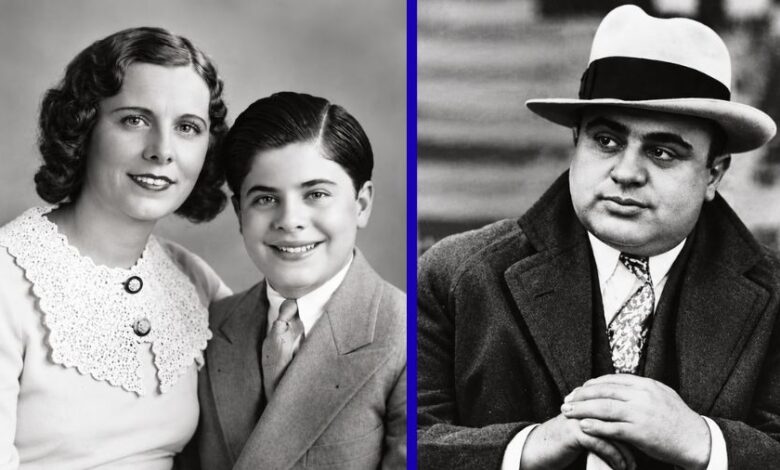
Mae Capone was the American woman best known as the wife of Al Capone, the notorious Chicago gangster whose name became synonymous with organized crime during the Prohibition era. Born Mary Josephine Coughlin in Brooklyn, New York, in 1897, Mae married Al Capone in 1918 and remained connected to him until his death in 1947. Although her husband’s criminal career brought enormous public attention to the Capone family, Mae largely lived outside the spotlight and is remembered primarily for her role as a wife, mother, and private family figure. Her story offers a different perspective on the Capone family, particularly through her marriage, her son Albert Francis “Sonny” Capone, her years in Florida, and the decades she lived after Al Capone’s death.
Quick Bio
| Fact | Details |
|---|---|
| Full Name | Mary Josephine Coughlin Capone |
| Known As | Mae Capone, Mae Coughlin |
| Born | April 11, 1897 |
| Birthplace | Brooklyn, New York, United States |
| Nationality | American |
| Family Background | Irish-American |
| Parents | Michael Coughlin and Bridget Gorman |
| Profession | Sales clerk before marriage; later primarily a private family figure |
| Spouse | Alphonse Gabriel Capone |
| Marriage Date | December 30, 1918 |
| Marriage Location | St. Mary Star of the Sea Church, Brooklyn |
| Children | One son, Albert Francis “Sonny” Capone |
| Known For | Being Al Capone’s wife and Sonny Capone’s mother |
| Relationship to Al Capone | Wife |
| Later Residence | Florida, including the Capone family home on Palm Island |
| Died | April 16, 1986 |
| Age at Death | 89 |
| Public Presence | Primarily known through historical records concerning the Capone family |
Who Is Mae Capone?
Mae Capone, whose birth name was Mary Josephine Coughlin, was the wife of Al Capone and one of the closest members of his immediate family throughout his adult life. She was born in Brooklyn on April 11, 1897, to Michael Coughlin and Bridget Gorman, whose family background was Irish. Mae grew up in Brooklyn and was part of an Irish-American Catholic household before marrying Al Capone in December 1918. Unlike her husband, she did not become a nationally known public figure through a profession or political role. Instead, her historical identity developed almost entirely through her family relationship with Al Capone and their only child, Albert Francis “Sonny” Capone. Her life is therefore particularly interesting to historians because it existed alongside one of the most dramatic criminal careers in American history without producing the same kind of public record. When people search for Mae Capone today, they are usually trying to understand who Al Capone’s wife really was, what her marriage was like, who their son was, and what happened to her after the gangster’s imprisonment and death.
Background in Private Family Life
Mae Capone’s early life was considerably more ordinary than the public history surrounding her later marriage. She was born and raised in Brooklyn during a period when large immigrant communities were shaping neighborhoods across New York City. Her parents, Michael Coughlin and Bridget Gorman, were Irish immigrants, and Mae grew up in an environment strongly influenced by Catholic family and community life. Available biographical records indicate that she attended school before working as a sales clerk. There is no substantial evidence that she developed a major independent public career before or after her marriage, and most surviving information about her comes from records concerning her family. This limited documentation is important because many later stories about Mae Capone have been repeated without clear evidence, particularly stories about her personality, private conversations, marriage and family circumstances. A reliable biography should therefore separate established facts from anecdotes that cannot be independently confirmed. What is clear is that Mae entered adulthood in Brooklyn and married Al Capone when both were still young, long before he became one of America’s most recognizable organized-crime figures. Her Irish-American background and Catholic upbringing also formed an important part of the family environment in which she raised her only child.
Marriage or Relationship with Al Capone
Mae Capone married Alphonse Gabriel Capone on December 30, 1918, at St. Mary Star of the Sea Church in Brooklyn, New York. The marriage took place before Al Capone’s later rise to national notoriety, when he was still a young man from Brooklyn rather than the internationally recognized gangster he would become during Prohibition. Mae was born in 1897, making her slightly older than Al, who was born in 1899. Historical accounts differ over the exact circumstances in which the couple first met, with some suggesting that they met socially in the Carroll Gardens neighborhood and others connecting the relationship to Al’s family and church circles. Because the precise beginning of their relationship is not documented with complete certainty, it is better not to present one version as unquestionable fact. Their marriage, however, is well established. Their wedding occurred only weeks after the birth of their son, Albert Francis Capone, who became known as Sonny. The couple’s marriage lasted throughout Al Capone’s rise in organized crime, his years of wealth and notoriety, his federal prosecution and imprisonment, and his later physical and mental decline. This long marriage is one reason Mae remains an important figure in accounts of Al Capone’s personal life. She was not simply a woman associated with him during his years of fame; she remained his wife through the major stages of his life and continued to be part of his immediate family during his final years.
Parenthood and Family Life
Mae Capone and Al Capone had one child, Albert Francis “Sonny” Capone, who was born in December 1918 shortly before his parents’ marriage. Sonny’s existence became an important part of the Capone family’s public story because he was the only child of one of America’s most notorious gangsters. Mae’s role as Sonny’s mother also distinguished her from the image of Al Capone that dominated newspapers and later popular culture. While Al was becoming increasingly involved in organized crime, Mae was associated primarily with the family’s private life and the upbringing of their son. Sonny did not become a criminal figure on the same scale as his father, and available accounts indicate that his family life was an important concern for Mae. The Capone family’s experiences also extended beyond Chicago, with Florida becoming increasingly important in later years. Mae became closely associated with the family’s Palm Island residence in Miami Beach, a property that eventually became one of the most recognizable physical reminders of Al Capone’s private life. Historical property records indicate that the residence was transferred to Mae in 1928, making her an important legal figure in the history of the house. The family connection to the property continued long after Al Capone’s criminal career had ended, and it became part of the historical record surrounding Mae, Sonny and the later years of the Capone family.
Supporting Through Al Capone’s Imprisonment and Declining Health
One of the most significant challenges in Mae Capone’s adult life was watching her husband move from the height of his criminal power to imprisonment and serious illness. Al Capone was convicted of federal tax offenses in 1931 and sentenced to 11 years in prison. He spent years incarcerated, including time at Alcatraz, before being released in 1939. His health had deteriorated substantially during and after imprisonment, and his later years were marked by severe medical problems and a significant decline in his mental condition. After his release, Al returned to Florida and lived with his family at the Palm Island residence. Mae therefore experienced a dramatic change in the circumstances surrounding her marriage. The man who had once commanded enormous attention in Chicago was now largely removed from the criminal world and living with serious health problems. Government historical records describe Al’s condition after prison and confirm that he spent his final years in Florida with his wife and immediate family. Mae’s presence during this period is one of the most important aspects of her documented life because it shows her connection with Al beyond his years of power and publicity. It is also a reminder that the final chapter of the Capone story was not centered on crime or wealth but on illness, family and isolation. Claims about the couple’s private medical circumstances should nevertheless be treated carefully, because some details repeated online are based on uncertain or disputed accounts rather than firmly documented evidence.
Life After Al Capone’s Death
Al Capone died on January 25, 1947, at his home on Palm Island in Florida after suffering serious health problems following years of illness. His death ended the period in which Mae Capone was directly connected to one of the most closely watched criminal figures in the United States, but Mae herself continued living for almost four more decades. Unlike her husband, she did not transform her notoriety into a public career, and she generally maintained a much lower profile. Her later years were therefore far less documented than the period of Al Capone’s criminal activities. Mae remained connected to the Capone family and lived in Florida, where the family had established an important part of its later life. Her long survival after Al’s death also meant that she lived through a period in which her husband’s reputation changed from contemporary criminal notoriety into historical mythology. Books, films, television programs and popular accounts repeatedly revisited Al Capone’s life, while Mae herself remained a comparatively private figure. She died on April 16, 1986, in Hollywood, Florida, at the age of 89. Her death came nearly 40 years after Al Capone’s, meaning she witnessed several decades of American history after the Prohibition era had ended. By the time she died, the world that had made her husband famous had become part of twentieth-century history, while Mae remained primarily remembered through her role within the Capone family.
Career Highlights and Public Recognition
Mae Capone did not have a major independent public career, so her historical recognition is fundamentally different from that of Al Capone. Her early employment as a sales clerk is one of the few details available about her working life before marriage, while most later records focus on her role within the family and her connection to the Palm Island residence. Her importance to historians comes from the fact that she was married to Al Capone for nearly three decades and was the mother of his only child. The Palm Island property is particularly significant because it provides documentary evidence of Mae’s place within the family’s financial and domestic history. The house became associated with the final years of Al Capone’s life and remained a recognizable part of the family’s story. Mae has also been represented in popular culture, including fictionalized portrayals connected with the Capone story. Such portrayals can introduce her to audiences who may know little about her, but dramatized productions should not be confused with historical documentation. The real Mae Capone appears to have lived a much quieter life than the dramatic versions sometimes presented on screen. Her public recognition rests mainly on her marriage, motherhood and place in the history of the Capone family rather than on an independent profession, political position or entertainment career.
Why People Search for Mae Capone
People search for Mae Capone mainly because they want to understand the woman behind the phrase “Al Capone’s wife” and learn what happened to the family after Al became one of the most famous gangsters of the Prohibition period. Common questions concern Mae’s real name, age, marriage, son, family background, relationship with Al Capone and life after his death. Interest in her also comes from the contrast between her relatively private existence and her husband’s enormous public reputation. Al Capone has been the subject of countless books, documentaries, films and historical investigations, but Mae’s story provides a more personal perspective on the same period. Her life also attracts attention because she stayed married to Al through years that included his rise to power, federal prosecution, imprisonment and declining health. Searches about Mae often overlap with questions about Sonny Capone, the Capone family’s Florida residence and the circumstances surrounding Al Capone’s final years. Another reason for continued interest is the difference between documented history and popular mythology. Many dramatic claims have circulated about the Capone family over the decades, but the strongest historical approach is to focus on facts supported by records and clearly identify information that remains uncertain. Mae Capone’s story is compelling without requiring exaggerated claims because her life naturally intersects with one of the most recognizable chapters in American criminal history.
Privacy, Accuracy and Public Information
The surviving information about Mae Capone is more limited than the extensive documentation available about Al Capone, and that difference should be respected when writing about her life. Her birth, marriage, child, family background, connection with the Palm Island property and death are among the better-documented aspects of her biography, while many details about her private thoughts, emotions and day-to-day experiences have not been publicly established with the same confidence. This is particularly important because Mae has sometimes been described through stories written many years after the events they supposedly describe. Some accounts disagree about how she met Al Capone, while other claims about the couple’s relationship, health and private family circumstances remain difficult to verify independently. A responsible biography should not convert such stories into facts simply because they have been repeated frequently. Mae was a private individual who became historically famous because of her marriage, and that distinction matters when evaluating claims about her. The available evidence supports describing her as Al Capone’s wife, Sonny Capone’s mother and a member of the family closely associated with the Palm Island residence. It does not justify attributing criminal activity, personal motivations or private opinions to her without reliable evidence. Where a detail has not been adequately documented, it is more accurate to say that the information has not been publicly established than to fill the gap with speculation.
Conclusion
Mae Capone’s life offers a quieter but revealing perspective on one of the most famous criminal figures of the twentieth century. Born Mary Josephine Coughlin in Brooklyn in 1897, she married Al Capone in 1918 and remained his wife until his death in 1947. Together they had one son, Albert Francis “Sonny” Capone, and their family later became closely associated with the Palm Island residence in Florida. Mae lived through Al’s transformation from a young Brooklyn man into a nationally notorious gangster, followed by his imprisonment and severe health decline. Yet her own historical identity remained largely centered on family rather than crime. She survived her husband by nearly four decades and died in Florida in 1986 at age 89. Although popular culture has repeatedly revisited the Capone story, Mae’s documented life is best understood without sensationalism. She was principally a wife, mother and private family figure whose connection to Al Capone placed her permanently within American history. Understanding Mae Capone therefore adds an important human and family dimension to the story of the Prohibition era while also showing why historical biographies should distinguish documented facts from mythology.
Also read: Cameron Herrin: His Life, Family, and the Case That Changed Everything
FAQs
Who was Mae Capone?
Mae Capone, born Mary Josephine Coughlin, was Al Capone’s wife and the mother of their only child, Albert Francis “Sonny” Capone.
When did Mae Capone marry Al Capone?
Mae Capone married Al Capone on December 30, 1918, at St. Mary Star of the Sea Church in Brooklyn, New York.
Did Mae Capone have children?
Yes. Mae and Al Capone had one son, Albert Francis “Sonny” Capone, born in December 1918 shortly before their marriage.
What happened to Mae Capone after Al Capone died?
Mae Capone continued living privately in Florida after Al Capone’s death and remained largely outside public attention until her death in 1986.
Where did Mae Capone live?
Mae Capone was associated with the Capone family’s Palm Island residence in Miami Beach, Florida, particularly during Al Capone’s later years.
When did Mae Capone die?
Mae Capone died on April 16, 1986, in Hollywood, Florida, at age 89, nearly four decades after Al Capone’s death.