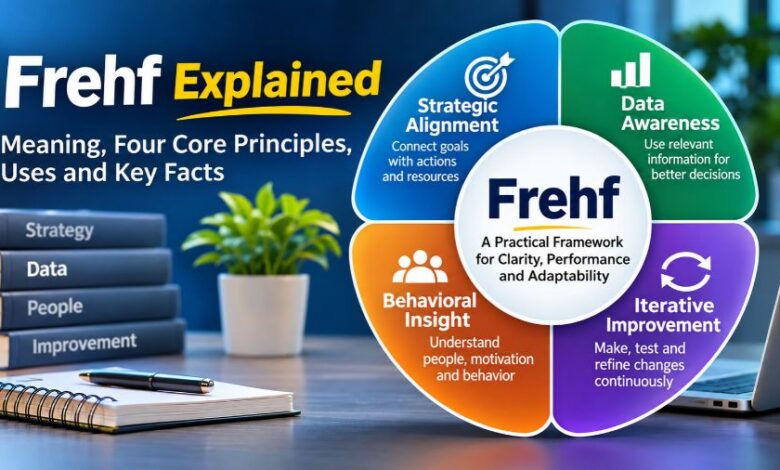
Frehf is an emerging online term associated with a structured approach to clarity, performance, decision-making, and long-term adaptability. Although it does not have one universally accepted definition, its most identifiable interpretation comes from a four-pillar framework involving Strategic Alignment, Data Awareness, Behavioral Insight, and Iterative Improvement. Understanding Frehf requires looking beyond repeated online definitions to examine its origins, practical principles, potential applications, limitations, and current status as an emerging concept.
What Is Frehf?
Frehf is an emerging concept most commonly associated with a structured framework for improving how individuals and organizations establish goals, make decisions, understand human behavior, and adapt to changing circumstances. Its four-pillar interpretation presents a way to connect strategic planning with practical execution rather than treating objectives, information, people, and improvement as separate activities. Historical content associated with Frehf.org described it as a practical framework that could be applied without specialized software. However, Frehf is not currently established as a recognized academic methodology, international standard, or widely validated business system. Its meaning also varies across online publications, making it important to distinguish the documented framework from interpretations that have not been independently verified.
What Does FREHF Stand For?
One commonly circulated interpretation expands FREHF as Future-Ready Enhanced Human Framework. This phrase appears in online discussions about adaptability, technology, human performance, and organizational development. However, available evidence does not conclusively establish it as the original or officially recognized full form of the term. The historical Frehf.org presentation focused more directly on four interconnected principles than on an acronym expansion. Consequently, readers should treat Future-Ready Enhanced Human Framework as a reported interpretation rather than a confirmed definition. This distinction matters because repeating an acronym expansion across multiple websites does not necessarily establish its origin, ownership, or official status.
The Four Core Principles of Frehf
The most clearly identifiable version of Frehf organizes its approach around four interconnected principles: Strategic Alignment, Data Awareness, Behavioral Insight, and Iterative Improvement. These principles address different parts of organizational decision-making, from defining objectives to evaluating results and adapting future actions. Together, they provide a practical way to think about how teams can reduce confusion, make informed decisions, understand the people involved, and improve their working methods. Although these concepts are not exclusive to Frehf, their combination offers a useful structure for discussing its central approach.
1. Strategic Alignment
Strategic Alignment focuses on connecting long-term objectives with everyday activities, available resources, and individual responsibilities. Organizations often struggle when departments work toward different priorities or when employees cannot see how their tasks contribute to wider business goals. This principle encourages decision-makers to establish clear objectives and translate them into manageable actions. For example, a company seeking to improve customer satisfaction might connect its overall target with customer support response times, product improvements, and employee training. The objective is to reduce the gap between planning and execution while ensuring that different teams understand their contributions.
2. Data Awareness
Data Awareness emphasizes using relevant information to support decisions rather than relying entirely on assumptions, personal opinions, or incomplete observations. Businesses generate information through customer interactions, operational activities, sales performance, and digital analytics, but collecting information alone does not guarantee better decisions. The important step is identifying meaningful indicators and understanding what they reveal about actual performance. For example, an online retailer might examine customer feedback, abandoned shopping carts, delivery times, and repeat purchases to identify problems in its customer experience. Within the Frehf interpretation, data awareness helps organizations recognize patterns, evaluate progress, and make adjustments based on available evidence.
3. Behavioral Insight
Behavioral Insight considers how people think, communicate, make decisions, and respond to different working environments. A strategy may appear effective on paper but fail when it does not account for employee motivation, customer expectations, communication difficulties, or resistance to change. This principle encourages organizations to consider human behavior when designing processes and introducing new initiatives. For example, introducing a new workplace application may require employee training, clear instructions, and opportunities to provide feedback. Understanding these human factors can help businesses identify friction points and create processes that are easier for people to adopt and maintain.
4. Iterative Improvement
Iterative Improvement involves making manageable changes, examining their results, and using the findings to improve subsequent decisions. Instead of assuming that one major transformation will solve every problem, this principle encourages a continuous process of evaluation and adjustment. A business might test a revised customer onboarding process with a small group, collect feedback, identify difficulties, and refine the experience before introducing it more widely. This approach is closely related to established continuous improvement practices and experimental methods used in business and technology. Within Frehf, iterative improvement connects the other three principles by turning objectives, information, and behavioral observations into practical changes.
How Does the Frehf Framework Work?
Frehf can be understood as a connected decision-making process rather than a specific software application or technical system. An organization begins by identifying what it wants to achieve and aligning its activities with that objective. It then examines relevant information, considers the people affected by its decisions, and chooses an appropriate course of action. After implementation, the organization evaluates the outcome and identifies opportunities for improvement. The process can then be repeated as circumstances change. This structure is useful because it connects planning with execution and evaluation, although its effectiveness depends on the quality of decisions, available evidence, and consistency of implementation rather than the framework’s name.
Practical Applications of Frehf
The four principles associated with Frehf can be considered in several professional and organizational environments. Their flexibility makes them relevant to discussions about business management, project planning, workplace development, digital operations, and organizational improvement. However, these applications should be understood as possible uses of the underlying principles, not as independently documented case studies proving the effectiveness of Frehf itself.
Frehf in Business Management
In business management, the framework can help leaders connect organizational objectives with departmental responsibilities and measurable operational activities. Strategic alignment establishes priorities, data awareness helps evaluate business performance, behavioral insight highlights employee and customer needs, and iterative improvement supports adjustments when results do not meet expectations. A growing company, for example, could use these principles when improving customer service or reorganizing internal workflows. The approach does not replace established management systems, but it can provide a useful structure for examining whether business decisions are connected to actual organizational needs.
Frehf in Technology and Digital Transformation
Technology projects frequently involve technical requirements, employee adoption, operational costs, and changing customer expectations. The principles associated with Frehf can help project teams consider these factors together instead of focusing exclusively on software features or implementation schedules. Strategic alignment connects technical work with business objectives, while data awareness helps teams examine system performance and user behavior. Behavioral insight highlights adoption challenges, and iterative improvement encourages testing and refinement. These ideas may be particularly relevant to organizations introducing automation, updating digital services, or improving existing technology infrastructure.
Frehf in Education and Learning
Educational institutions and training organizations can also apply similar principles when developing learning programs and evaluating educational outcomes. Strategic alignment helps connect learning objectives with teaching activities, while data awareness supports the examination of student progress and participation. Behavioral insight encourages educators to consider different learning needs, motivation, and classroom engagement. Iterative improvement provides opportunities to revise teaching materials and instructional methods based on feedback. Although these practices are not unique to Frehf, organizing them together can help educational teams approach learning improvement more systematically.
Frehf in Team Collaboration
Effective teamwork requires clear responsibilities, reliable communication, shared objectives, and opportunities to resolve problems. The Frehf approach encourages teams to understand how individual contributions support collective goals while using feedback and performance information to identify weaknesses. Behavioral insight is particularly relevant because communication styles, motivation, and workplace expectations can influence collaboration. Regular evaluation also allows teams to recognize ineffective processes before they become larger operational problems. These principles can support collaborative working environments without requiring organizations to purchase specialized tools or adopt an entirely new management structure.
Potential Benefits of the Frehf Approach
The potential value of Frehf comes from bringing several familiar organizational principles into one connected approach. Clear objectives can reduce confusion about priorities, while informed decision-making can help teams avoid unnecessary assumptions. Understanding human behavior can make organizational changes more practical, and continuous improvement can encourage employees to learn from results rather than treating initial plans as permanent solutions. Another potential advantage is flexibility because the principles can be considered in different organizational environments without requiring a particular software platform. However, these are reasonable benefits of the underlying management practices, not independently proven performance results attributable specifically to Frehf.
Frehf Compared With Traditional Management Frameworks
Frehf is sometimes discussed alongside established approaches such as Objectives and Key Results (OKRs), Agile, and continuous improvement. However, these approaches have different purposes and levels of formal development. OKRs provide a structured method for defining objectives and measurable key results, while Agile describes a family of approaches emphasizing iterative delivery, collaboration, and adaptation. Continuous improvement focuses on regularly identifying and addressing opportunities to improve processes. The Frehf interpretation combines themes that overlap with these established practices, including strategic alignment, feedback, human behavior, and adaptation. It is therefore more accurate to consider it a broad conceptual framework than a proven replacement for established management methodologies.
Challenges and Limitations of Frehf
Despite its potentially useful principles, Frehf has several important limitations that readers should understand before treating it as an established professional system. Its origins and authorship are not clearly documented, its commonly reported acronym expansion is not conclusively verified, and there is insufficient independent research demonstrating the effectiveness of Frehf as a distinct framework. The four pillars also overlap with existing management and organizational development concepts, meaning the framework does not necessarily introduce entirely new methods. Additionally, organizations may struggle to apply its principles consistently if objectives are unclear, data quality is poor, employees are not involved, or improvement activities lack measurable outcomes. These limitations make careful evaluation more important than accepting promotional descriptions.
Is Frehf a Real Framework, Software, or Company?
Frehf has an identifiable online presence as a term and was previously presented through Frehf.org as a structured framework for clarity, performance, and adaptability. However, the available evidence does not establish it as a major software platform, registered commercial technology product, or formally recognized international business standard. The historical website described a methodology that could be applied without specialized software, although some third-party articles have attached additional technology and AI-related interpretations to the name. A current check of Frehf.org on October 31, 2026, shows a domain-expiration notice rather than the previous framework content. A website’s former existence and a framework’s conceptual description should therefore not be confused with evidence of an active company or operating software service.
What Is the Future of Frehf?
The future significance of Frehf depends on whether its principles receive clearer documentation, identifiable authorship, practical examples, and independent evaluation. The underlying themes of strategic alignment, data-informed decisions, human understanding, and continuous improvement remain relevant to organizations facing technological and operational changes. However, the framework would need stronger evidence and a more clearly defined methodology to gain recognition beyond its current online presence. If its principles are developed into measurable practices and supported by independently documented outcomes, they could become easier to evaluate and apply. Until then, Frehf is best approached as an emerging conceptual framework rather than an established management standard or proven technology solution.
Conclusion
Frehf is an emerging online concept most clearly associated with four principles: Strategic Alignment, Data Awareness, Behavioral Insight, and Iterative Improvement. These ideas offer a practical way to examine how individuals and organizations establish goals, use information, understand human behavior, and respond to changing conditions. Nevertheless, its official meaning, original authorship, and independent validation remain uncertain, and there is insufficient evidence to describe it as established software or a recognized industry standard. Understanding this distinction allows readers to explore the framework’s useful ideas without confusing an emerging online term with a formally validated methodology.
Also read: Bilieter Explained: Meaning, Website Purpose, and SEO Insights
FAQs
What does Frehf mean?
Frehf is an emerging online term associated with a framework for improving strategic clarity, informed decision-making, human understanding, and continuous organizational improvement.
What does FREHF stand for?
Some online publications expand FREHF as Future-Ready Enhanced Human Framework, but available evidence does not confirm this as its official original meaning.
What are the four pillars of Frehf?
The four commonly associated pillars are Strategic Alignment, Data Awareness, Behavioral Insight, and Iterative Improvement, which connect planning, decisions, people, and evaluation.
Is Frehf an app or software?
Frehf is most clearly documented as a conceptual framework rather than a verified standalone software application or established digital technology platform.
Who created the Frehf framework?
The original creator or founding organization behind the four-pillar framework has not been reliably identified through the publicly available information reviewed.
Is Frehf a scientifically proven framework?
No independent scientific validation of Frehf as a distinct framework has been established, although its individual principles overlap with recognized management practices.