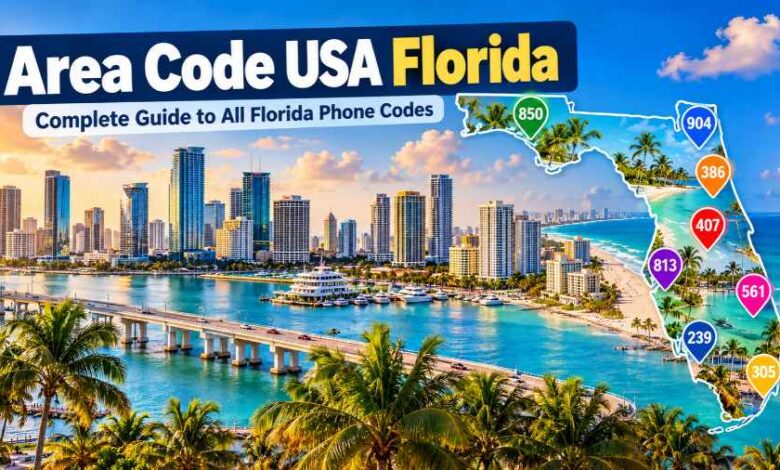
What Is the Area Code for Florida, USA?
Florida does not have a single statewide telephone area code. Instead, the state uses multiple three-digit area codes assigned to different geographic regions. These codes form part of the North American Numbering Plan, which serves the United States, Canada, and several other participating countries and territories. A typical Florida telephone number follows the format (XXX) XXX-XXXX, where the first three digits represent the area code, the next three digits identify the central office or exchange code, and the final four digits identify the individual telephone line within that numbering block. Because some regions have multiple overlapping area codes, two people living in the same city may have different area codes.
Complete List of Florida Area Codes and Their Locations
Florida has 23 active geographic area codes, including original codes and newer codes introduced to expand the supply of available telephone numbers. The coverage areas include major metropolitan cities, coastal communities, inland towns, and rural regions. Some newer codes share the same geographic territory as older codes, so the area code alone does not always identify a unique city. The following sections explain the principal regions associated with Florida’s telephone codes and help readers narrow down the likely location of a number.
Miami and South Florida: 305, 645, and 786
Miami and much of the surrounding area use 305, 786, and 645. Area code 305 is one of Florida’s original telephone codes and has a long association with Miami and the Florida Keys. Code 786 was introduced as an overlay to expand numbering capacity, while 645 became another overlay in 2023. These codes can serve the same general territory, which means a Miami resident may have any of the three. They are particularly relevant when identifying calls associated with Miami, Hialeah, Miami-Dade County, and nearby communities.
Orlando and Central Florida: 321, 407, and 689
The Orlando metropolitan area is primarily associated with area codes 407 and 689, while 321 has a more specific history connected to Florida’s Space Coast and also serves parts of the greater Orlando region. Area code 407 was introduced in 1988, and 689 was added in 2019 to provide additional telephone numbers in the 407 region. Code 321 was originally associated with the Space Coast, including communities near Cape Canaveral and Melbourne. Because coverage arrangements differ by code, callers should check the specific location rather than assuming that every 321 number belongs to Orlando or that every Orlando number uses 407.
Jacksonville and Northeast Florida: 904 and 324
Jacksonville and surrounding communities in Northeast Florida use area codes 904 and 324. Code 904 has served the region for decades, while 324 entered service on February 26, 2024, as an overlay intended to increase the availability of phone numbers. Both codes can be associated with Jacksonville and nearby communities, including Jacksonville Beach and Orange Park. Existing customers generally keep their established numbers when an overlay is introduced, while new numbers may be assigned the newer code. Ten-digit dialing is required for local calls in this overlay region.
Tampa Bay: 813 and 656
Area codes 813 and 656 serve the Tampa region and nearby communities in Hillsborough County. The original 813 code dates back to 1953, while 656 was introduced in 2022 as an overlay to expand the number supply. Both codes can appear on numbers associated with Tampa and surrounding communities such as Brandon and other parts of the metropolitan area. An unfamiliar 656 number is therefore not necessarily from a different city; it may belong to the same general service region as an 813 number.
Fort Lauderdale and Broward County: 954 and 754
Fort Lauderdale and much of Broward County are associated with area codes 954 and 754. Code 954 was introduced in 1995, and 754 followed in 2001 as an overlay. Both codes serve the same general geographic area, including communities such as Hollywood, Pembroke Pines, and Coral Springs. Businesses, residents, and organizations in this region may use either code. When reviewing a phone number from South Florida, it is useful to distinguish Broward County’s 954 and 754 area from the neighboring Miami-Dade region, which commonly uses 305, 786, and 645.
West Palm Beach and Palm Beach County: 561 and 728
Area codes 561 and 728 serve Palm Beach County and the surrounding region, including West Palm Beach and Boca Raton. Code 561 was introduced in 1996, and 728 entered service in 2023 as an overlay. Both codes can be assigned within the same general coverage area. These numbers may appear on personal phones, business contact details, medical office listings, and other local services. Although Palm Beach County is geographically close to Broward and Miami-Dade counties, its principal area-code pairing is different, making 561 and 728 useful identifiers when examining a Florida telephone number.
Southwest Florida: 239
Area code 239 covers much of Southwest Florida, including Fort Myers, Naples, Cape Coral, and surrounding communities. It entered service in 2002 after the region’s telephone numbering requirements outgrew the previous arrangement. Unlike several major Florida metropolitan areas, 239 is not paired with a statewide overlay code in the current list of active Florida area codes. However, its precise geographic coverage should not be inferred solely from a city name because numbering boundaries do not always follow county or municipal boundaries exactly.
North Central Florida: 352
Area code 352 serves a broad portion of North Central Florida, including Gainesville, Ocala, and nearby communities. It was introduced in 1995 as Florida’s population and telephone demand continued to expand. The region includes university communities, residential areas, and smaller towns, so a 352 number may be associated with different types of callers. It is useful for identifying the general part of the state, but it does not establish the caller’s exact address, current location, or identity.
Florida Panhandle: 850 and 448
The Florida Panhandle, including communities associated with Tallahassee and Pensacola, uses area codes 850 and 448. Code 850 entered service in 1997, and 448 was introduced in 2021 as an overlay to provide additional numbering capacity. These codes are relevant to people contacting state government offices, educational institutions, businesses, and residents across the Panhandle. Florida extends across two time zones, and portions of the Panhandle observe Central Time, unlike much of the state, which observes Eastern Time. A caller should therefore verify the recipient’s local time before scheduling a call.
St. Petersburg and Clearwater: 727
Area code 727 serves the St. Petersburg and Clearwater region, including communities around Florida’s Tampa Bay area. It was introduced in 1998 when the previous regional numbering arrangement was divided. The code is commonly associated with Pinellas County and nearby communities, although exact numbering boundaries can vary. It is distinct from Tampa’s primary 813 and 656 pairing, even though the communities served by these codes are geographically close and economically connected.
Sarasota and Bradenton: 941
Area code 941 is associated with Florida’s Gulf Coast, particularly Sarasota, Bradenton, and nearby communities. It entered service in 1995 and serves a mix of residential, tourism, healthcare, and business locations. A 941 number can be useful when recognizing a call associated with this part of the state, but it should not be treated as proof that a caller is physically in Sarasota or Bradenton. Mobile-number portability and internet-based calling make the relationship between a phone number and a person’s current location less certain.
Port St. Lucie and the Treasure Coast: 772
Area code 772 serves the Treasure Coast, including Port St. Lucie, Fort Pierce, and nearby communities. It entered service in 2002 after being separated from a larger regional numbering area. The region includes residential neighborhoods, coastal businesses, and local services. When a number begins with 772, the code provides a useful geographic clue, but it does not identify the specific town or person without additional, reliable information.
Lakeland and Central Inland Florida: 863
Area code 863 covers parts of inland Central Florida, including Lakeland, Winter Haven, and other surrounding communities. It entered service in 1999 and serves areas distinct from the main Tampa Bay and Orlando metropolitan numbering regions. Because Florida’s inland communities can be less familiar to people outside the state, knowing the 863 code can help distinguish a number associated with this region from numbers originating in the larger coastal metropolitan areas.
Daytona Beach and North Central East Florida: 386
Area code 386 serves areas that include Daytona Beach and communities across parts of North Central and Northeast Florida. It entered service in 2001. The region includes coastal destinations, residential communities, and inland towns, so the code is not limited to Daytona Beach itself. When looking up a 386 number, users should confirm the associated city through a reliable directory or the organization that provided the number rather than assuming that every caller is located on the coast.
How Florida Area Codes Work
Florida’s telephone area codes operate within the North American Numbering Plan, which organizes telephone numbers across participating countries and territories. A standard ten-digit number consists of a three-digit area code followed by a seven-digit local number. Telephone providers receive number blocks and assign numbers to customers according to applicable numbering rules and service availability. As demand grows, regulators and numbering administrators may introduce an additional area code or overlay to make more numbers available. Area codes are therefore part of the telephone network’s addressing system, rather than a reliable method of verifying a person’s identity or physical location.
What Is an Area Code Overlay?
An overlay occurs when a new area code is introduced to serve the same geographic region as an existing code. Instead of dividing a region into separate territories, the new code adds numbering capacity without requiring existing customers to change their phone numbers. Florida uses overlays in several populated regions, including Miami, Orlando, Jacksonville, Tampa, the Panhandle, and Palm Beach County. This approach helps maintain existing telephone numbers while allowing new customers and additional lines to receive numbers from the expanded pool. In overlay regions, callers generally need to dial the full ten-digit number even when making a local call.
Why Does Florida Have So Many Area Codes?
Florida’s many area codes reflect decades of growth in population, businesses, mobile communications, and demand for additional telephone numbers. As more residents and organizations require phone lines, the supply of numbers available within an existing code can become insufficient. Introducing an overlay is one way to address this challenge without changing every existing number. Historical splits and later overlays have shaped the state’s current numbering system. The number of area codes should not be interpreted as a direct measure of population, however, because numbering capacity, allocation methods, and local demand all influence how many codes a region requires.
How to Dial a Florida Phone Number
Dialing a Florida number is straightforward once you know whether you are calling from within the United States or from another country. For most calls, the important detail is to use the complete area code and seven-digit local number. The international format adds the United States country calling code, +1, before the ten-digit number. Mobile phones commonly accept numbers entered with the country code, which can be useful for people who regularly contact American businesses or relatives from overseas. The correct format can depend on the originating telephone network, so international callers should follow their provider’s dialing instructions if a call does not connect.
Calling Florida From Within the United States
When calling a Florida number from elsewhere in the United States, dial the ten-digit number: the three-digit area code followed by the seven-digit local number. For example, a fictional number could be written as (305) 555-0100. In an area where ten-digit dialing is required, including the area code is necessary even for a local call. Some numbering regions have different dialing-plan rules, so it is sensible to use all ten digits whenever possible. If you are calling a business, use the complete number listed on its verified website or official correspondence.
Calling Florida From Outside the United States
To call a Florida telephone number from another country, begin with the international access prefix required by your country or use the plus sign on a compatible mobile phone. Then enter the United States country code, 1, followed by the Florida area code and the seven-digit local number. For example, a fictional Miami number would use the format +1 305 555 0100. The plus sign allows compatible devices and networks to apply the appropriate international dialing prefix automatically. International calling rates vary by provider and plan, so check your charges before placing a lengthy call.
Understanding the Difference Between +1 and a Florida Area Code
The number +1 is the country calling code for the North American Numbering Plan, which includes the United States and several other participating countries and territories. It is not Florida’s area code. Florida’s geographic area codes are the three-digit numbers that follow the country code in an international telephone number. For example, +1 305 indicates a number using area code 305 within the North American numbering system. Understanding this distinction helps prevent dialing errors, especially when saving international contacts or entering telephone numbers into business forms and customer databases.
How to Identify the Region of a Florida Phone Number
An area code can provide a useful first clue about the region associated with a Florida number. For example, 305 is strongly associated with Miami, 407 with Orlando, 813 with Tampa, and 904 with Jacksonville. However, an area code cannot reliably establish the current location of a caller because people may keep their numbers when moving, and mobile or internet-based services can be used from different locations. For more reliable identification, compare the complete number with an official business directory, the organization’s verified contact page, or information supplied directly by the person you are trying to reach.
Can You Find a City Using Only an Area Code?
You can often estimate a phone number’s original numbering region from its area code, but you cannot always determine the precise city. Overlay codes may cover the same territory, while some numbering regions include multiple cities and communities. Additionally, mobile-number portability allows many customers to retain their numbers when changing providers, and internet calling can separate a number from the caller’s physical location. A city lookup should therefore be treated as a geographic indication rather than a definitive location result. If the exact address or identity matters, use independently verified information and respect the person’s privacy.
Does a Florida Area Code Prove That a Call Is Genuine?
No. A Florida area code does not prove that a caller is trustworthy, lives in Florida, or represents a legitimate organization. Caller ID information can be manipulated through a technique commonly called spoofing, in which the displayed number is made to appear different from the originating number. If a caller requests payment, passwords, verification codes, or sensitive personal information, do not rely on the displayed area code as evidence of authenticity. Instead, end the call and contact the organization using a phone number obtained independently from its official website, account statement, or other trusted source.
The History of Florida Telephone Area Codes
Florida’s area-code history reflects the expansion of telephone service across the state. Area code 305 was established in 1947, making it one of the state’s oldest codes. As demand increased, new codes were introduced to serve different regions, and existing regions were divided or supplemented with overlays. Major additions included 407 for the Orlando region, 561 for Palm Beach County, 954 for Broward County, and later codes such as 689, 448, 656, 728, 645, and 324. These changes helped increase numbering capacity while allowing many existing subscribers to retain their established telephone numbers.
The Introduction of Newer Area Codes
Florida’s newer area codes illustrate how overlays expand the available supply of phone numbers. Code 689 joined the 407 region in 2019, 448 joined the 850 region in 2021, and 656 joined the 813 region in 2022. Codes 728 and 645 followed in 2023, serving the same general territories as 561 and 305, respectively. In 2024, code 324 was introduced as an overlay for the 904 region. These additions did not mean that existing customers automatically had to replace their telephone numbers. Instead, they created more numbering options for new assignments and additional lines in the affected regions.
Choosing the Right Florida Area Code for Business
For businesses, Florida area codes can be relevant when establishing a local contact number, opening a regional office, or communicating with customers in a specific market. A business serving Miami may prefer a number associated with the Miami region, while an organization focused on Jacksonville may use a 904 or 324 number. A local number can help customers recognize the geographic market a business serves, but it does not by itself prove that the business has a physical office in that city. Companies should provide accurate business addresses, clear contact information, and consistent customer support details to build trust.
Area Codes for Local Marketing and Customer Support
Businesses may use local telephone numbers to make their contact information easier for customers to recognize. For instance, a company marketing services in Tampa might use an 813 or 656 number, while a business serving Palm Beach County might use 561 or 728. The most suitable choice depends on number availability, provider support, target customers, and the company’s actual service area. Companies should not imply that they have a local office if they do not. A transparent approach that accurately describes service coverage is more valuable than relying on an area code alone to create a local impression.
Area Codes and Online Business Listings
Businesses should keep telephone numbers consistent across their websites, business directories, customer communications, and relevant online listings. Consistent contact details help customers verify that they are contacting the correct organization and reduce confusion when numbers change. However, an area code is only one part of a business’s contact information; it is not sufficient to establish legitimacy, service quality, or search-engine ranking. Companies should prioritize accurate details, accessible customer support, and reliable business information rather than assuming that a particular Florida area code will automatically improve online visibility.
Common Mistakes to Avoid When Using Florida Area Codes
One common mistake is assuming that every Florida city has only one area code. Overlay arrangements mean that multiple codes may serve the same geographic region. Another mistake is confusing the United States country code, +1, with a Florida area code. Some callers also assume that a number’s area code reveals where the person currently lives, even though number portability and internet calling make that conclusion unreliable. Finally, people may trust unfamiliar callers simply because the number appears local. Checking the complete number, confirming important details independently, and understanding local dialing requirements can help prevent these errors.
Conclusion: Area Code USA Florida
Florida’s telephone numbering system includes 23 active area codes serving cities and communities across the state. Codes such as 305, 407, 813, and 904 are associated with major metropolitan regions, while newer overlay codes provide additional numbering capacity without requiring existing customers to change their numbers. Understanding the difference between a country calling code and a geographic area code makes domestic and international dialing easier. Although area codes can help identify a number’s general service region, they cannot independently verify a caller’s identity or current location. Checking complete numbers and confirming important contact details through trusted sources remain essential when communicating with Florida residents and businesses.
Also read: Quad Equalizer Explained: Uses, Audio Settings, and Signal Technology
FAQs
1. What is the area code for Florida, USA?
Florida has 23 active area codes, including 305, 407, 813, and 904. The correct code depends on the specific city or region.
2. What is the most famous Florida area code?
Area code 305 is widely associated with Miami and the Florida Keys. It is also one of Florida’s oldest telephone area codes.
3. What is the area code for Miami, Florida?
Miami uses area codes 305, 786, and 645. These codes overlap geographically, so residents and businesses may have different codes within the same region.
4. What is the area code for Orlando, Florida?
Orlando primarily uses 407 and 689, while 321 also serves parts of the greater Orlando area and is associated with Florida’s Space Coast.
5. How do I call Florida from another country?
Dial your country’s international access prefix or use a plus sign, followed by the US country code +1 and the complete ten-digit number.
6. Can I identify a caller’s location using a Florida area code?
An area code can suggest a number’s original service region, but number portability, mobile services, and caller ID spoofing prevent reliable location verification.