What Actually Fits Inside a Trailer: A Planning Guide for Mobile Command Centers, Kitchens and Stage Units

Every purpose-built mobile unit starts life as a wish list and ends life as a compromise between weight, width and the way people actually move around a room. Whether the asset is an incident command trailer for a county emergency agency, a kitchen trailer feeding a festival, or a branded vehicle running a six-month tour, the planning discipline is the same: define the work the unit has to do, then let the floor plan and the chassis follow. Get that order wrong and you end up with a beautiful build that nobody enjoys using.
This guide walks through the decisions that matter most when you are specifying, outfitting and budgeting a mobile unit — and the trade-offs that are easiest to miss until the unit is parked and in service.
Start with the mission profile, not the trailer length
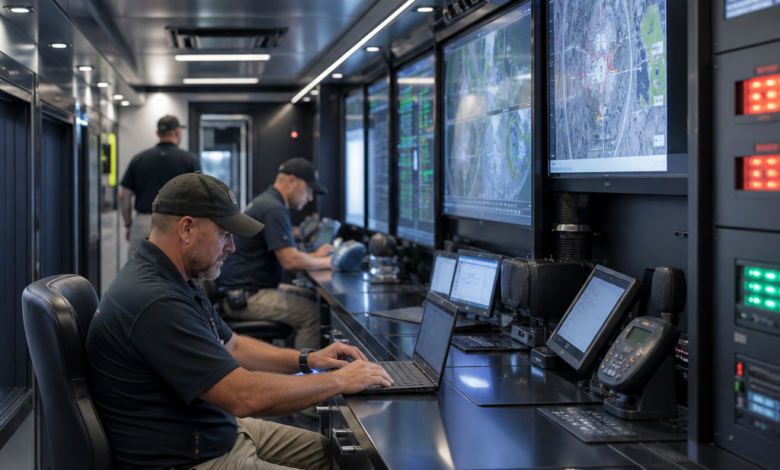
Before anyone sketches a layout, write down what happens inside the unit on its busiest day. For a command vehicle, that might be six people at workstations, two radios in use, a wall display driving a briefing, and a steady stream of people coming in to sign something. For a mobile kitchen, it is the peak-hour ticket count, the menu’s cooking methods, and how many staff can realistically work shoulder to shoulder without colliding at the pass.
Those details decide everything downstream: how much counter run you need, how many power circuits, whether you need a separate quiet space, how big the HVAC load is, and ultimately whether a 24-foot unit will do or whether you are honestly looking at something far longer. A useful exercise is to tape the proposed floor plan onto a warehouse floor or car park and walk it with the people who will use it. Chairs, aisle widths and door swings reveal themselves quickly.
Four numbers worth writing into the brief
- Peak occupancy — how many people inside at once, seated and standing.
- Electrical load — the realistic simultaneous draw, not the sum of every nameplate rating.
- Deployment time — how many minutes you have from arrival to operational, and how many people are available to set up.
- Tow and storage reality — what vehicles and drivers you have, and where the unit lives between deployments.
The usable-space problem, and why slide-outs change the maths
Road-legal width caps the interior of any trailer, which means a long unit still gives you a corridor rather than a room. That geometry is fine for storage and equipment racks and poor for anything collaborative: a conference table, a briefing wall, a kitchen line with two cooks passing each other. Expandable sections solve the problem by trading a few minutes of setup for a genuinely different shape of interior once parked.
The trade-offs are real and worth facing early. Expandable sections add mechanical and electrical systems that need maintenance, consume payload, and require clear ground on at least one side of the unit — which affects where you can stage the asset on a narrow street or a packed event site. They also change your sequence of operations, because the unit has to be levelled and secured before anything extends. Agencies that specify them tend to do so because the alternative — towing two units to achieve one usable room — costs more over the life of the asset.
Where a specialist fabricator earns its place
This is the point where most buyers stop designing in isolation and bring in a builder who has solved the same problems before. Craftsmen Industries is a custom industrial fabrication company that designs and builds specialty mobile units and trailers — mobile command centers and command trailers, Class C mobile command coaches, commercial kitchen and custom food trailers, mobile stage trailers, film set trailers, and promotional and experiential marketing vehicles — and its technical writing on how expandable sections are engineered is a sensible place to start if you are weighing the option. Their explanation of how mobile command trailer slide-outs work covers the mechanics, the setup sequence and the design implications in enough detail to inform a specification rather than just a wish list. Whatever builder you talk to, the useful conversation is the one that happens before the layout is frozen, because moving a bulkhead on paper is free and moving it in steel is not.
What actually drives the budget
Cost conversations go badly when the two sides are comparing a bare shell to a finished operational asset. Without quoting figures, the drivers are reasonably predictable:
- Size and chassis class — length, axle count and whether you need a self-propelled coach rather than a towed trailer.
- Expandable sections — each one adds structure, seals, drive systems and commissioning time.
- Power and climate — generator capacity, shore power, battery systems and HVAC sized for a full room of people and equipment.
- Technology fit-out — displays, racks, cabling pathways and the labour to integrate it all tidily.
- Interior finish — millwork, seating, flooring and the storage that stops gear migrating onto the floor.
- Exterior graphics — a major factor for marketing vehicles, minor for a command unit.
Build a contingency into the programme for the things discovered during commissioning, and budget separately for the operating life: tyres, generator servicing, annual inspections, insurance and storage. A unit that sits outdoors in weather ages differently from one kept under cover.
Two very different use cases, one design logic
Emergency and public safety
In an incident, the mobile unit is the only fixed point in a chaotic environment. What matters is speed to operational, communications that work when networks are degraded, a briefing area where ten people can see the same map, and enough separation that a radio operator is not sitting inside a planning discussion. Multi-agency deployments add another requirement: visitors who have never been inside your unit should be able to find the plotting board and the sign-in point without being shown.
Brand activations, food service and live events
Commercial units are judged on throughput and on how they look in a photograph. Queue management, a clear service window, graphics that survive motorway grime, and a setup crew small enough to be affordable all shape the design. Marketers tracking where experiential spend is heading will find useful context in the 2025 experiential trends report from BizBash, which is a reminder that a vehicle built for a single campaign idea tends to be retired early, while a reconfigurable one keeps earning.
Treat it as a capital project, because it is one
A specialty mobile unit is a multi-year asset with an operating cost, a utilisation rate and a replacement horizon — the same frame used for any plant purchase. That framing is exactly the kind of analysis emphasised in postgraduate management programmes; readers weighing a step into that sort of decision-making role will recognise the skillset discussed in this look at why an MBA in Singapore appeals to future business leaders. Apply it here: estimate annual deployments, cost per deployment, and what the alternative (renting, or building a temporary site each time) would cost over five years. The answer usually clarifies whether to buy small and flexible or large and fully equipped.
A short pre-build checklist
- Walk a taped-out floor plan with the people who will work inside it.
- Confirm the tow vehicle, driver licensing and storage before approving the length.
- List every powered device and calculate the realistic simultaneous load.
- Decide the setup crew size, then test whether the design can be deployed by that many people.
- Write the maintenance and inspection plan into the project, not after it.
- Specify storage for everything that currently lives in a plastic crate.
Units that stay in service for a decade are rarely the ones with the longest feature list. They are the ones where the layout matched how people actually worked, the power system was sized honestly, and someone thought about setup day before they thought about the graphics.
READ ALSO: Wisely by ADP Explained: Paycard Features, Benefits and How It Works