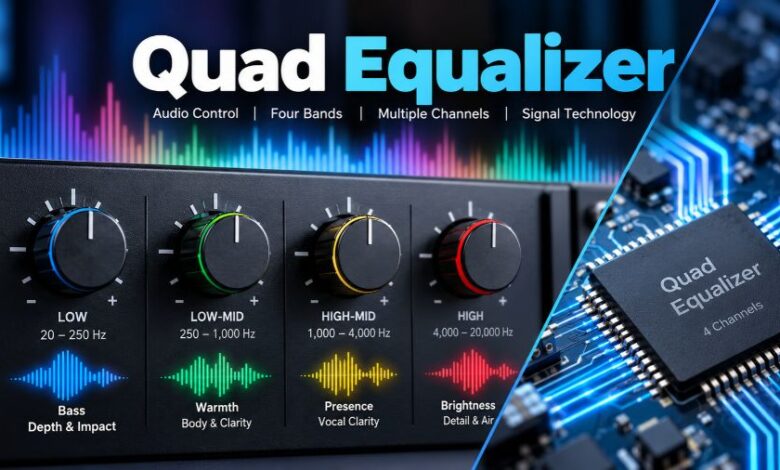
Quad Equalizer is a term used in audio and electronics to describe equalization systems that work with four frequency bands or four independent signal channels, depending on the device. In audio applications, equalizers help adjust bass, midrange, and treble to improve tonal balance, while electronic signal equalizers compensate for signal loss during high-speed data transmission. Understanding these different meanings is important when researching audio equipment, sound-processing software, or electronic components. This guide explains how a quad equalizer works, its main applications, practical adjustment techniques, advantages, limitations, and the differences between audio equalization and high-speed signal conditioning.
What Is a Quad Equalizer?
A quad equalizer is an equalization system associated with four adjustable sections, four signal channels, or four equalization paths. The precise meaning depends on the equipment and the context in which the term appears. In consumer audio, it may refer to a four-band equalizer that provides control over different parts of the audible frequency spectrum. In professional audio equipment, quad may describe a device that processes four separate audio channels, each potentially containing multiple frequency filters. In electronics, the term can describe a four-channel signal equalizer designed to compensate for transmission losses in high-speed digital communication. Because these applications serve different purposes, the product documentation should always be checked before assuming that a quad equalizer has exactly four frequency controls.
How Does a Quad Equalizer Work?
A quad equalizer works by changing the relative strength of selected frequency components within a signal. In audio systems, boosting a frequency range makes that portion of the sound more prominent, while cutting it reduces its contribution to the overall tonal balance. These adjustments can help control excessive bass, improve vocal presence, or reduce harsh high frequencies. In high-speed electronics, equalization serves a different function by compensating for frequency-dependent losses that occur as electrical signals travel through cables, circuit-board traces, and other transmission channels. Electronic equalizers can help receivers interpret transmitted data more reliably by improving the signal characteristics before further processing. Although both applications use the principle of equalization, audio EQ shapes perceived sound, whereas digital signal equalization helps preserve the integrity of transmitted information.
Frequency Selection and Gain Control
Frequency and gain are two important concepts in audio equalization. Frequency, measured in hertz, identifies the portion of the sound spectrum being adjusted, while gain determines how much that portion is increased or reduced. Some equalizers provide fixed frequency controls, whereas others allow users to select specific frequencies. A parametric equalizer may also offer bandwidth or Q controls, which determine how broadly an adjustment affects neighboring frequencies. These parameters allow sound engineers to make either broad tonal changes or more targeted corrections. The exact controls available on a quad equalizer depend on its design, so users should consult the relevant manual rather than assume every device supports the same adjustments.
Four Bands Versus Four Channels
The distinction between four bands and four channels is essential when interpreting the term quad equalizer. A four-band equalizer divides a signal’s frequency spectrum into four adjustable regions, such as low, low-mid, high-mid, and high frequencies. A four-channel equalizer, however, processes four separate signal paths, and each path may have its own collection of frequency controls. For example, professional audio hardware might process four independent inputs while providing several EQ filters for every channel. A high-speed electronic component may similarly handle four data channels without having anything to do with bass or treble controls. Therefore, four bands describe frequency-control sections, while four channels describe separate signal paths.
The Four Main Frequency Ranges in Audio Equalization
A typical four-band audio equalizer provides broad control over the low, low-mid, high-mid, and high-frequency portions of an audio signal. These regions influence different aspects of the listening experience, including bass weight, warmth, vocal presence, and perceived brightness. However, their exact boundaries are not universal. One equalizer may use different center frequencies or filter characteristics from another, and some designs allow frequency selection while others use fixed settings. Understanding the general role of each range helps users make informed adjustments without relying on arbitrary presets. The goal is to achieve a balanced sound appropriate for the recording and playback equipment rather than maximize every frequency.
Low Frequencies
Low frequencies contribute bass weight, depth, and impact to music and other audio content. They help define kick drums, bass guitars, deep synthesizer notes, and low-frequency effects in films and games. Increasing this range can make sound feel fuller, particularly when the playback system has limited bass output. However, excessive boosting may produce a boomy or muddy result, consume available signal headroom, and make other elements less distinct. Reducing unnecessary low-frequency energy can sometimes improve clarity, especially in recordings affected by rumble or excessive bass. The appropriate adjustment depends on the recording, the capabilities of the headphones or speakers, and the acoustic environment.
Low-Mid Frequencies
The low-midrange contributes much of the body and warmth heard in voices and musical instruments. When this region is balanced, vocals can sound natural and instruments can retain their character. Excessive energy may make recordings seem congested, boxy, or muddy, particularly when several instruments occupy similar frequency ranges. Reducing an offending area can help create separation between instruments, although broad cuts may also remove useful warmth. The best adjustment depends on the source material and the behavior of the playback system. A four-band equalizer provides relatively broad control, so a parametric equalizer may be more suitable when a problem occurs within a very narrow frequency range.
High-Mid Frequencies
High-mid frequencies contribute to vocal presence, articulation, and the definition of many instruments. Adjustments in this region can influence how clearly speech is perceived and how prominently guitars, percussion, and other sounds stand out in a mix. A carefully chosen increase may help a voice become more noticeable, while a reduction may soften an aggressive or tiring recording. However, excessive boosting can emphasize harshness or make certain sounds uncomfortable to hear. High-mid adjustments should therefore be made gradually and evaluated using familiar recordings. Equalization can improve tonal balance, but it cannot completely correct poor microphone placement, excessive room reverberation, or other problems that originate during recording.
High Frequencies
High frequencies contribute brightness, fine detail, and the definition of sounds such as cymbals, some consonants, and high-pitched musical elements. A modest increase may make a recording seem more open, while a reduction can help control excessive sharpness or hiss. The results depend on the source material and playback equipment because different headphones and speakers reproduce high frequencies differently. Excessive treble boosting may emphasize sibilance, introduce an unpleasant tonal balance, or reduce listening comfort. Users should also recognize that increasing high frequencies does not restore information that was never captured in the original recording. The purpose of equalization is to adjust existing frequency content, not recreate missing audio detail.
Common Applications of a Quad Equalizer
Quad equalizers can be useful in several audio environments, including music listening, podcast production, vocal processing, gaming, and public-address systems. Their usefulness depends on the type of equalizer, the number of channels it supports, and the level of control it offers. A simple four-band EQ is convenient for broad adjustments, while professional equipment may provide more sophisticated processing for multiple independent inputs. Equalization can help address tonal imbalances and make particular sounds more suitable for their intended environment. Nevertheless, it is only one part of a complete audio system, and its effectiveness depends on the quality of the source, the playback equipment, and the acoustic conditions.
Music Listening and Home Audio
In home audio systems, a four-band equalizer can help listeners adjust the sound to suit their preferences and equipment. Someone who finds bass overpowering may reduce low frequencies, while a listener who finds a recording too sharp may reduce the relevant high-frequency range. These adjustments can be useful with headphones, desktop speakers, stereo systems, and compatible audio software. However, the same settings will not necessarily produce identical results on different devices because their frequency responses and acoustic environments vary. A sensible starting point is a neutral EQ setting followed by small changes. Comparing the adjusted sound with the original helps determine whether the modification genuinely improves the listening experience.
Vocals, Podcasts, and Voice Recording
Voice recording is another practical application of equalization. A quad equalizer may help reduce excessive low-frequency energy, adjust vocal warmth, or improve perceived speech presence. These changes can make dialogue sound more balanced when used appropriately. However, not every voice requires the same treatment, and a setting that improves one speaker may sound unnatural on another. Microphone distance, room acoustics, background noise, and recording levels often have a significant influence on clarity. An equalizer cannot remove every type of noise or compensate fully for a poorly recorded signal. For podcasts and voiceovers, recording clean audio at the source should remain the priority, with EQ used as a supporting tool.
Gaming, Movies, and Entertainment
Equalization can help users customize game audio, film soundtracks, and general entertainment. A listener may prefer less bass during dialogue-heavy content or a different tonal balance for headphones used during gaming. Adjusting selected frequencies can change the perceived prominence of footsteps, voices, explosions, and musical effects, depending on how those sounds are mixed. However, EQ does not automatically create accurate directional audio or improve every aspect of a gaming headset. Positional sound depends on the game’s audio engine, the playback hardware, and any spatial-processing features in use. A quad equalizer should therefore be viewed as a tonal adjustment tool rather than a replacement for proper spatial-audio technology.
Professional Audio and Live Sound
Professional audio environments use equalization to shape sound from microphones, instruments, and playback systems. A four-channel equalizer can be particularly useful when several independent signals need processing within one unit. Engineers may use EQ to adjust tonal balance, reduce problematic frequency peaks, and help speech remain intelligible in a venue. However, live-sound equalization requires attention to microphone placement, loudspeaker position, room acoustics, and system gain. Indiscriminate boosting can make feedback more likely, while excessive cutting may degrade sound quality. Equalization is most effective when applied carefully as part of a properly configured sound system rather than used to compensate for every acoustic problem.
Quad Equalizer in High-Speed Digital Electronics
In electronics, a quad equalizer can refer to an integrated circuit that compensates for signal degradation across four high-speed data channels. This application is fundamentally different from adjusting the tonal balance of music. When digital signals travel through cables or printed circuit-board traces, the transmission path may attenuate some frequency components more strongly than others. The resulting signal can become harder for the receiving circuit to interpret, particularly at high data rates. A signal equalizer compensates for some of these transmission losses and can help reduce certain forms of signal distortion. Its purpose is to improve data integrity within the limitations of the complete transmission system.
How Digital Signal Equalization Helps
Digital signal equalization helps compensate for characteristics of the physical transmission channel. As a signal passes through a cable or circuit-board trace, its shape can change because of frequency-dependent losses and other electrical effects. An equalizer applies compensation to help the receiver recover the transmitted information more reliably. The required correction depends on the data rate, transmission medium, channel characteristics, and capabilities of the selected component. Some equalizers offer programmable compensation levels so designers can adapt the device to different signal paths. Nevertheless, equalization cannot correct every design problem, and successful high-speed communication also depends on circuit layout, impedance control, connectors, clock quality, and receiver performance.
Example of a Four-Channel Equalizer
The Texas Instruments DS32EV400 is a documented example of a DisplayPort quad equalizer. Its specifications describe four data channels and programmable input equalization for high-speed signal transmission. The component is designed to compensate for transmission-medium losses and reduce medium-induced deterministic jitter under its specified operating conditions. Its published features include eight programmable equalization levels per channel and support for data rates up to 3.2 gigabits per second. This illustrates why the term quad equalizer should not automatically be interpreted as a four-band audio control. In semiconductor documentation, it can describe a specialized component for conditioning high-speed data rather than changing the sound of music.
Quad Equalizer Versus Graphic and Parametric Equalizers
A quad equalizer is not necessarily a separate filter architecture. The word quad generally describes a four-part configuration, but it does not reveal whether the device uses graphic, parametric, or another equalization design. A graphic equalizer typically provides fixed frequency bands with individual gain controls, while a parametric equalizer generally offers more precise control over the selected frequency, gain, and bandwidth. A four-band parametric equalizer combines four frequency sections with adjustable parameters, whereas a four-channel graphic equalizer may provide numerous frequency bands for each of its four channels. Choosing between these systems depends on the required precision, workflow, and signal-processing needs rather than the name alone.
When a Four-Band EQ Is Appropriate
A four-band EQ is a practical choice when the main objective is straightforward tonal adjustment. Its limited number of controls makes it easier to understand and can reduce the time needed to correct broad sound imbalances. This simplicity is useful for everyday listening, basic audio production, and applications where detailed frequency targeting is unnecessary. The trade-off is reduced precision compared with more advanced equalizers. If an unwanted resonance occurs between the available frequency points, a four-band design may not provide enough control to isolate it without affecting neighboring frequencies. Users who need detailed corrections may benefit from a parametric EQ or another system with finer adjustment options.
When a Parametric EQ Is More Suitable
A parametric equalizer is useful when a specific frequency problem needs more precise treatment. Depending on its design, it allows users to select a center frequency, adjust the amount of boost or cut, and control the width of the affected frequency range. This flexibility can help address narrow resonances, problematic vocal frequencies, or specific tonal imbalances without changing a broad section of the spectrum unnecessarily. However, additional controls require a better understanding of equalization and can make the interface more complicated for beginners. A parametric EQ is not automatically better for every situation; a simpler equalizer may be entirely sufficient when only broad adjustments are required.
Benefits and Limitations of a Quad Equalizer
The main benefit of a quad equalizer is that it provides a structured way to adjust or compensate for selected parts of a signal. In audio, a four-band design can offer accessible tonal control without the complexity of a large professional equalizer. A four-channel design can also process multiple independent signals within a single device. In electronics, a quad equalizer can help address transmission losses across several data channels. However, the term alone does not guarantee any particular level of performance, precision, or compatibility. The results depend on the underlying design, available controls, signal requirements, and implementation. Equalization also has limits: excessive audio boosts can cause clipping, and electronic compensation cannot overcome every limitation of a poor transmission channel.
How to Adjust a Quad Equalizer Effectively
The best way to adjust an audio quad equalizer is to begin with a neutral setting and identify a specific issue before changing any controls. If the sound is muddy, investigate whether excessive low or low-mid energy is responsible. If vocals lack presence, a small adjustment in the relevant midrange may help. If the sound is too sharp, consider reducing the high-frequency region rather than boosting other bands. Make one change at a time and compare the result with the original signal at a similar listening volume. Avoid increasing every band simply to make the audio seem louder, because that can reduce headroom and make meaningful comparisons difficult. If the adjustment makes the sound less natural, return to the previous setting and try a smaller change.
Common Mistakes When Using a Quad Equalizer
A common mistake is assuming that stronger bass or brighter treble automatically produces better sound. Large adjustments can make a recording less balanced and may conceal other important details. Another mistake is copying settings designed for different headphones, speakers, rooms, or recordings without checking the results. Users may also confuse four frequency bands with four independent channels and purchase equipment that does not match their intended application. In professional audio, excessive boosting can increase the risk of feedback, while in digital electronics, selecting the wrong equalization characteristics can compromise signal integrity. Reading the manufacturer’s specifications, understanding the signal path, and making measured adjustments can help avoid these problems.
Conclusion
A quad equalizer can describe a four-band audio equalizer, a four-channel audio processor, or a four-channel electronic signal equalizer, depending on the product and application. In audio, it helps users shape tonal balance by adjusting frequency ranges, while in high-speed electronics, it compensates for transmission losses that can affect digital signals. Understanding the difference between frequency bands and independent channels is essential when choosing or researching a device. For everyday audio applications, modest adjustments and careful comparisons usually produce more useful results than extreme settings. For electronic applications, the correct component must be selected according to the data rate, channel characteristics, and technical requirements of the system.
Also read: What Is Acamento? Meaning, Origins, Uses, and Everything You Should Know
FAQs About Quad Equalizer
1. What is a quad equalizer used for?
A quad equalizer adjusts selected audio frequencies or processes four independent signal channels, depending on its design. It can shape sound or compensate for electronic transmission losses.
2. Is a quad equalizer the same as a four-band EQ?
Not always. A four-band EQ has four frequency sections, while a quad equalizer may instead refer to equipment processing four separate signal channels.
3. What are the four frequency bands in an audio equalizer?
A typical four-band audio EQ controls low, low-mid, high-mid, and high frequencies. The exact frequency ranges depend on the equalizer’s design and specifications.
4. What are the best quad equalizer settings for music?
Start with a flat setting and make small adjustments based on the recording and playback equipment. No single preset works best for every listener.
5. Can a quad equalizer improve vocal clarity?
Yes, audio equalization can improve perceived vocal clarity by adjusting problematic frequency ranges. However, microphone placement, recording quality, and room acoustics also matter.
6. What is a quad equalizer in digital electronics?
In digital electronics, a quad equalizer can be a four-channel component that compensates for transmission losses, helping high-speed data signals maintain reliable characteristics.
Meta Description:
SEO Keywords: