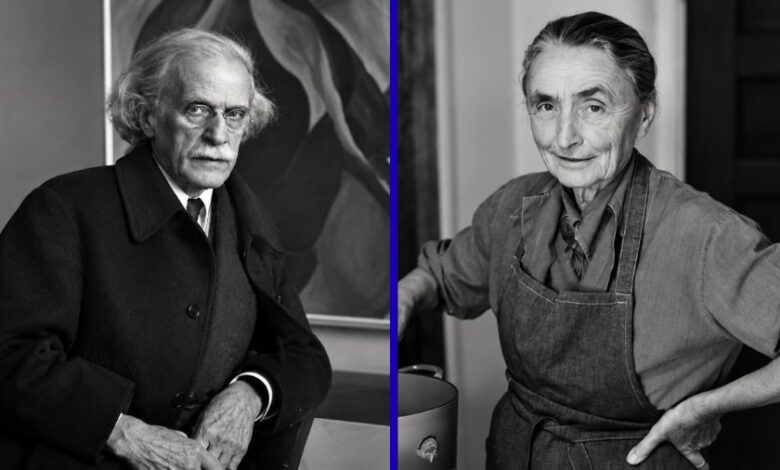
Alfred Stieglitz was an influential American photographer, publisher, gallery director, and champion of modern art whose career helped establish photography as a serious fine-art medium while his marriage to Georgia O’Keeffe connected two major figures in American art. Born in Hoboken, New Jersey, in 1864, Stieglitz spent decades photographing urban life, landscapes, portraits, and clouds while creating important platforms for modern artists. His galleries and publications introduced American audiences to major European artists, while his long photographic study of Georgia O’Keeffe became one of the most recognizable portrait projects in the history of photography. His family background, complicated first marriage, relationship with O’Keeffe, and enduring artistic influence continue to make Alfred Stieglitz a subject of interest for readers researching photography, modernism, Georgia O’Keeffe, and American cultural history.
Quick Bio
| Fact | Verified Information |
|---|---|
| Full Name | Alfred Stieglitz |
| Known As | Alfred Stieglitz |
| Profession | Photographer, publisher, gallery director, and promoter of modern art |
| Nationality | American |
| Birthplace | Hoboken, New Jersey, United States |
| Birth Year | 1864 |
| Education | Technische Hochschule in Berlin, where he studied engineering and photography |
| Father | Edward Stieglitz |
| Mother | Hedwig Werner Stieglitz |
| First Wife | Emmeline “Emmy” Obermeyer |
| Second Wife | Georgia O’Keeffe |
| Children | Katherine “Kitty” Stieglitz was his daughter with Emmy |
| Known For | Fine-art photography, Camera Work, 291 gallery, and promoting modern art |
| Relationship to Georgia O’Keeffe | Husband and major supporter of her artistic career |
| Death | 1946 in New York City |
| Major Legacy | Helping establish photography as fine art and promoting modernism in America |
Who Is Alfred Stieglitz?
Alfred Stieglitz was one of the central figures in the development of modern photography and American modernism during the late 19th and early 20th centuries. He was born on January 1, 1864, in Hoboken, New Jersey, as the eldest child of Edward Stieglitz and Hedwig Werner Stieglitz, immigrants whose family placed considerable value on culture, education, and the arts. His father was a successful wool merchant and an amateur artist and art collector, giving Alfred an early connection to the artistic world. Stieglitz eventually became far more than a photographer: he was an editor, publisher, exhibition organizer, gallery director, critic, and advocate who used institutions and publications to change how photography was understood. After studying in Berlin, he became increasingly committed to photography and developed a sophisticated understanding of photographic chemistry, optics, printing, composition, and artistic expression. His career moved through several important stages, beginning with the pictorial photography associated with the Photo-Secession and later developing toward sharper, more direct photographic approaches. His influence expanded through publications such as Camera Work and galleries including 291, The Intimate Gallery, and An American Place. Through these platforms, Alfred Stieglitz helped introduce American audiences to influential European artists while also supporting American painters, photographers, and sculptors. His importance therefore rests not only on individual photographs but also on the cultural network he built around modern art.
Background in Photography and Modern Art
Alfred Stieglitz’s professional development was shaped by his education in Germany and his determination to make photography intellectually and artistically respected. He enrolled at the Technische Hochschule in Berlin in 1882, where his studies included engineering, but photography increasingly became his central interest. He studied under Hermann Wilhelm Vogel, an important authority on photographic chemistry and technology, and the experience gave Stieglitz a strong technical foundation. During the 1890s, he became active in American photographic organizations and publications while experimenting with composition, light, atmosphere, printing techniques, and photographic subjects. He became associated with Pictorialism, an approach that emphasized mood, atmosphere, artistic composition, and printing methods capable of giving photographs a painterly appearance. In 1902, he helped establish the Photo-Secession, a group dedicated to advancing photography as a fine art. His influence grew further when he edited and published Camera Work from 1903 to 1917, an ambitious quarterly journal celebrated for its sophisticated presentation of photography and its engagement with contemporary art. His gallery at 291 Fifth Avenue became another crucial platform, first known as the Little Galleries of the Photo-Secession and later simply as 291. The gallery eventually displayed photography alongside modern European and American art, helping New York audiences encounter new artistic ideas. Stieglitz organized exhibitions featuring artists such as Pablo Picasso, Henri Matisse, Georges Braque, and Paul Cézanne, while also supporting American figures including Arthur Dove, Marsden Hartley, John Marin, Charles Demuth, and Georgia O’Keeffe. His own photographic work evolved during these years, with The Steerage becoming an especially important example of his changing visual language. His later cloud photographs, often associated with the title Equivalents, explored abstraction and the expressive possibilities of photography. Together, his photographs, publications, and galleries made Alfred Stieglitz a key figure in the transition from traditional pictorial photography toward modernist visual culture.
Marriage or Relationship with Georgia O’Keeffe
Alfred Stieglitz and Georgia O’Keeffe developed one of the most important personal and professional relationships in American art history, beginning with Stieglitz’s discovery of her abstract drawings and eventually leading to marriage. Stieglitz first encountered O’Keeffe’s work in 1916 and exhibited her drawings at his 291 gallery, recognizing the originality of her approach before she had achieved widespread recognition. Their relationship became personal after O’Keeffe moved to New York in 1918 with Stieglitz’s financial and professional support. At the time, Stieglitz was still legally married to Emmeline “Emmy” Obermeyer, whom he had married in 1893. Their marriage had become deeply unhappy, and they eventually divorced in 1924. Stieglitz and O’Keeffe married that same year. Their partnership combined affection, artistic admiration, professional collaboration, and considerable personal complexity. Stieglitz photographed O’Keeffe extensively, producing what he regarded as a composite portrait rather than a conventional collection of isolated portraits. Over approximately 19 years, he made 331 finished photographs of her, including images of her face, hands, torso, clothing, and other details. The series changed considerably as their relationship developed, moving from intensely intimate early portraits toward photographs reflecting greater independence and emotional distance in later years. At the same time, Stieglitz consistently promoted O’Keeffe’s work through his galleries and exhibitions, helping strengthen her position within the American art world. O’Keeffe’s career eventually moved increasingly toward New Mexico, where the landscape, architecture, animal bones, and desert environment became central sources for her art. Although the couple experienced periods of distance and difficulty, they remained married until Stieglitz died in 1946. Their relationship is therefore significant not simply because Alfred Stieglitz was Georgia O’Keeffe’s husband, but because their lives and artistic careers became closely intertwined during a transformative period in American art.
Parenthood and Family Life
Family was an important part of Alfred Stieglitz’s private life, although his public reputation has understandably been dominated by photography and his relationship with Georgia O’Keeffe. Stieglitz was the eldest of six children born to Edward Stieglitz and Hedwig Werner Stieglitz. His siblings included Flora, twins Julius and Leopold, Agnes, and Selma, and several members of the family remained connected to him throughout his life. His father, Edward Stieglitz, had built a successful business supplying woolen cloth and was also an amateur painter and art collector, while his mother, Hedwig, had a strong interest in literature, music, and visual art. These circumstances gave Alfred an unusually rich cultural environment during childhood. His own first marriage to Emmeline Obermeyer produced one child, Katherine “Kitty” Stieglitz, born in 1898. Katherine graduated from Smith College in 1921 and married Milton Sprague Stearns in 1922. She had a son in 1923, but subsequently experienced severe and persistent mental-health difficulties and remained institutionalized for the remainder of her life. Alfred’s family connections also extended into his professional and artistic circles. His sister Agnes married George Herbert Engelhard and had a daughter, Georgia Engelhard, who became close to both Alfred Stieglitz and Georgia O’Keeffe. Stieglitz photographed members of his family on numerous occasions, and family gatherings at Lake George became part of the visual record preserved in his photographs. His siblings Julius and Leopold pursued different professional paths: Julius became a prominent chemist associated with the University of Chicago, while Leopold became a physician in New York. Selma Stieglitz Schubart was another younger sister and was herself photographed by Alfred, including in an important 1907 Autochrome portrait. These family relationships demonstrate that Stieglitz’s photographic interests were not restricted to famous artists; his camera also documented relatives, friends, colleagues, and the broader social world surrounding him.
Supporting Through a Transformative Artistic Partnership
The most consequential form of support in Alfred Stieglitz’s later life was his sustained promotion of Georgia O’Keeffe’s career at a time when her artistic identity was still developing. After exhibiting her drawings in 1916, Stieglitz continued to present her work through his galleries and encouraged her move to New York in 1918. His support provided O’Keeffe with greater access to the professional art world, collectors, critics, and other artists, although her eventual reputation rested on her own distinctive artistic achievement. Stieglitz’s photographs also played an unusual role in shaping public perceptions of O’Keeffe. Rather than producing a small collection of formal portraits, he photographed her repeatedly over many years, creating a visual biography through hundreds of separate images. The project allowed him to study changes in her appearance, gestures, clothing, posture, and personality, while also connecting her body with her artistic identity. At times, the photographs were highly intimate, and their presentation became part of the complex public mythology surrounding the couple. O’Keeffe eventually developed a more independent professional life, particularly through her work in New Mexico, while Stieglitz remained based largely in New York. Their changing circumstances reflected a broader transformation in their marriage and careers. Despite those changes, Stieglitz continued exhibiting O’Keeffe’s work until his death, and she later played a major role in organizing and distributing his artistic estate. Their partnership therefore functioned in both directions: Stieglitz helped promote O’Keeffe, while O’Keeffe ultimately became one of the principal figures responsible for preserving and distributing his legacy.
Life After 291 and His Later Career
The closure of 291 in 1917 did not end Alfred Stieglitz’s influence; instead, it marked the beginning of another phase in which his photography and advocacy became increasingly personal and focused. During the years following 291, Stieglitz concentrated more heavily on photography, particularly portraits of Georgia O’Keeffe and his celebrated studies of clouds. His cloud photographs, which he eventually associated with the concept of Equivalents, represented an important exploration of abstraction because they encouraged viewers to interpret forms and tonal relationships without relying on recognizable narrative subjects. In 1925, Stieglitz opened The Intimate Gallery, where he continued presenting American modernist art and photography. In 1929, he established An American Place, which remained active until his death in 1946. These later galleries allowed him to continue supporting artists even as the American art world changed around him. Stieglitz’s personal life also became more complicated during the 1930s. Georgia O’Keeffe increasingly pursued her own artistic direction and spent substantial periods in New Mexico, while Stieglitz became involved in a close relationship with Dorothy Norman. His health deteriorated during the later years of his life, and in 1937 he effectively stopped making photographs because of poor health. Even after putting aside his camera, however, he remained deeply engaged with art and with the artists associated with his galleries. O’Keeffe’s growing independence did not erase their marriage, and the two remained legally married until his death. Stieglitz died in New York City on July 13, 1946, at the age of 82. After his death, O’Keeffe devoted considerable time to organizing his extensive collection and helping determine how his photographs and other works would be preserved and distributed. This posthumous stewardship became an important part of Stieglitz’s lasting artistic legacy.
Career Highlights and Public Recognition
Alfred Stieglitz’s career stands out because he transformed several interconnected areas of American cultural life rather than limiting himself to photography alone. His early photographic experiments demonstrated technical ambition, while his involvement with Pictorialism and the Photo-Secession helped argue that photography deserved recognition alongside painting and sculpture. Camera Work became one of the most influential photographic publications of its era, combining sophisticated reproductions with critical discussion and presenting photography within a wider artistic context. The 291 gallery was equally significant because it brought photography into direct conversation with European modernism and helped American audiences encounter artists whose ideas would reshape visual culture. Stieglitz’s own work also continued to evolve. The Steerage, photographed in 1907, became a landmark image because its geometric organization and contrasting forms anticipated aspects of modernist abstraction. His portraits of Georgia O’Keeffe became an extraordinary long-term study of a single person, eventually reaching 331 finished photographs. His cloud photographs similarly challenged conventional assumptions about photographic subject matter and representation. In addition to these achievements, Stieglitz supported a generation of American artists, including Arthur Dove, John Marin, Marsden Hartley, Charles Demuth, and others associated with his galleries. His influence was therefore institutional as well as artistic: he created places where artists could exhibit, publishers could reproduce their work, critics could debate new ideas, and audiences could encounter unfamiliar forms of modern art. By the time of his death, Stieglitz had helped establish a cultural environment in which photography could be regarded as a serious artistic medium rather than merely a mechanical recording process. His recognition today rests on that combined legacy of photographic innovation, artistic advocacy, publishing, exhibition-making, and mentorship.
Why People Search for Alfred Stieglitz
People search for Alfred Stieglitz for several overlapping reasons, with his connection to Georgia O’Keeffe being one of the strongest sources of interest. Readers researching O’Keeffe often encounter Stieglitz because he was her husband, an early exhibitor of her work, and the photographer responsible for an extraordinary body of portraits documenting her over many years. Photography enthusiasts search for him because of works such as The Steerage and Equivalents, while students of modern art study him because of his role in introducing European avant-garde movements to American audiences. Others are interested in Camera Work, the Photo-Secession, 291, and his later galleries because these institutions helped change the direction of American visual culture. His family history also attracts attention because several relatives appear in his photographs and because his siblings followed notable professional paths outside the arts. The names Katherine Stieglitz, Edward Stieglitz, Hedwig Ann Werner, Julius Stieglitz, Leopold Stieglitz, Agnes Stieglitz Engelhard, Flora Stieglitz Stern, and Selma Stieglitz Schubart therefore belong to a broader family story that provides context for understanding the person behind the famous photographer. For readers, the most useful way to understand Alfred Stieglitz is not as a celebrity biography but as the story of a determined cultural figure whose photography, publishing, galleries, family relationships, and partnership with Georgia O’Keeffe intersected with the emergence of American modernism.
Privacy, Accuracy and Public Information
Much of Alfred Stieglitz’s life is exceptionally well documented because his photographs, letters, exhibitions, publications, family records, and artistic archives have been preserved by major cultural institutions, but not every detail found online is equally reliable. Publicly documented information strongly supports his birth in Hoboken in 1864, his parents Edward and Hedwig, his siblings, education in Berlin, marriages to Emmeline Obermeyer and Georgia O’Keeffe, daughter Katherine, professional work in photography and publishing, major galleries, and death in New York in 1946. Some genealogical websites contain conflicting or poorly supported family-tree information, so unsupported claims about additional children, private relationships, financial matters, or undocumented family events should not be treated as established facts. The names of family members such as Flora Stieglitz Stern and Selma Stieglitz Schubart can be connected to historical records and Stieglitz’s own photographs, while more detailed biographical information about some relatives is comparatively limited in authoritative public sources. It is also important to distinguish documented history from interpretations of the Stieglitz-O’Keeffe relationship: their marriage was artistically productive but also complicated, and surviving records reveal changes in intimacy, independence, and professional priorities over time. A responsible biography should therefore focus on evidence preserved in museum collections, archival records, scholarly publications, and historical documentation rather than presenting unverified private claims as fact.
Conclusion
Alfred Stieglitz remains an essential figure in the history of American photography because his achievement extended far beyond the production of memorable photographs. He helped argue that photography could function as a serious fine-art discipline, created influential publishing and exhibition platforms, introduced American audiences to important European modernists, and supported emerging American artists whose work would shape the country’s modernist tradition. His personal history adds another dimension to that legacy, particularly his marriage to Georgia O’Keeffe and his extraordinary 331-image photographic study of her. At the same time, his family story, including his parents Edward Stieglitz and Hedwig Ann Werner and siblings such as Julius, Leopold, Agnes, Flora, and Selma, reveals a broader cultural environment that surrounded his development. Stieglitz died in 1946, but his influence continued through the photographs, artists, institutions, and collections connected to his life’s work. Georgia O’Keeffe’s later role in preserving and distributing his estate further strengthened the connection between their artistic legacies. Today, Alfred Stieglitz is remembered not simply as Georgia O’Keeffe’s husband or as an accomplished photographer, but as one of the individuals who helped redefine the place of photography and modern art in American culture.
Also read: John Henry Kelley: Michelle Pfeiffer’s Son and His Private Life
FAQs
Who was Alfred Stieglitz?
Alfred Stieglitz was an American photographer, publisher, and gallery director who helped establish photography as fine art and promoted modern European and American artists.
Was Alfred Stieglitz married to Georgia O’Keeffe?
Yes, Alfred Stieglitz married Georgia O’Keeffe in 1924 after their relationship developed from his early exhibition and promotion of her artwork.
How many photographs did Stieglitz make of Georgia O’Keeffe?
Stieglitz created 331 finished photographs of Georgia O’Keeffe over approximately nineteen years, describing the collection as a composite portrait.
Did Alfred Stieglitz have children?
Yes, Alfred Stieglitz had one daughter, Katherine “Kitty” Stieglitz, with his first wife, Emmeline Obermeyer, born in 1898.
Who were Alfred Stieglitz’s parents?
Alfred Stieglitz was the eldest child of Edward Stieglitz, a successful businessman and art collector, and Hedwig Werner Stieglitz.
What was Alfred Stieglitz best known for?
He was best known for pioneering fine-art photography, publishing Camera Work, operating influential galleries, and promoting artists including Georgia O’Keeffe.