Low Power, Hard Starting and Smoke: Diagnosing a Diesel Fuel Fault Before You Pull the Pump

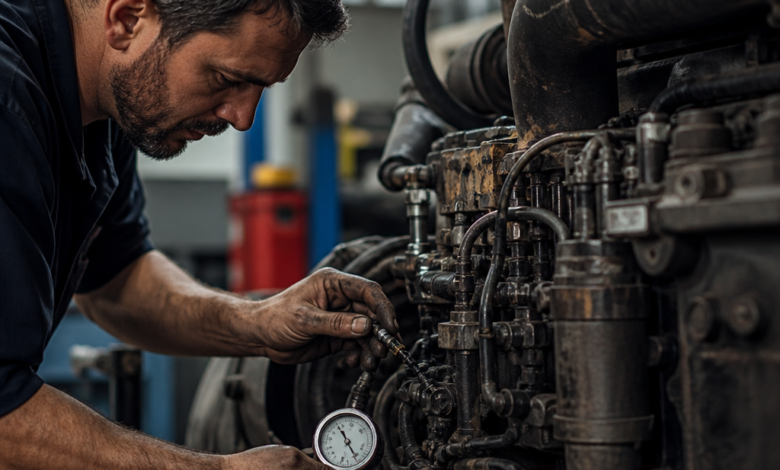
An injection pump is the most expensive part most people guess at. A truck cranks for ten seconds instead of two, loses power up a hill, and someone decides the pump is “tired”. Two days later the pump is off the engine, the timing cover is open, and the real fault turns out to be a collapsed suction hose or a boost leak at the intercooler. The order in which you test matters more than the tools you own, so here is a sequence that keeps the cheap checks first and the expensive assumptions last.
What the pump actually does — and where the turbo fits in
A diesel injection pump has two jobs: build pressure high enough to atomise fuel against compressed air, and deliver a measured quantity at an exact crank angle. Mechanical rotary and inline pumps do the metering with plungers, barrels, delivery valves and a governor. Common rail systems split the work — a high-pressure pump feeds a rail, and the ECM decides timing and quantity through the injectors. That split matters when you diagnose: on a mechanical system, a fuelling fault usually lives in the pump; on common rail, the pump may be perfectly healthy while a leaking injector or a rail pressure sensor causes the identical symptom.
The turbocharger is the other half of the equation. Fuel without air makes smoke and heat, not power. A worn turbo, a cracked charge pipe or a sticking variable-geometry mechanism will mimic a fuelling fault almost exactly — black smoke, sluggish throttle response, high exhaust temperature. Before condemning anything on the fuel side, confirm the engine is getting the air it was designed to breathe. If you want the underlying layout in plain language, this primer on how diesel fuel systems are arranged is a sensible refresher on tanks, lifts, filters and return lines before you start chasing pressures.
Read the symptoms properly
Hard starting when cold, fine when warm
Classic for low cranking compression, failed glow plugs or grid heater, or air leaking into the supply side overnight. A pump that genuinely cannot build pressure rarely improves once warm. Crack a line at the pump inlet with the engine off and look for froth or a slow fuel drain-back — a tank-to-pump leak will happily let fuel stay in the lines but pull air under suction.
Power loss under load only
Restriction. Fuel filters, a kinked or swollen flexible line, a blocked tank pickup screen, or a weak lift pump. These faults hide at idle because demand is tiny. Measure inlet restriction with a vacuum gauge on the suction side while the engine is pulling, not while it idles in the yard.
White smoke and a knock
Unburnt fuel. Think retarded timing, a dribbling injector or nozzle, or a failed delivery valve letting pressure bleed back. Pull the nozzles and have them pop-tested; a nozzle that opens low or sprays a stream instead of a cone will ruin economy and coat a piston long before the pump is to blame.
Surging or hunting at idle
Governor and air-ingress territory on mechanical pumps, rail-pressure regulation on common rail. On electronically controlled systems, log rail pressure against commanded pressure before touching hardware — a pump that cannot hold commanded pressure at hot idle while the return volume is excessive is usually telling you an injector is leaking internally.
A test order that saves money
- Fuel quality first. Drain a sample into a clear jar. Water, bacterial sludge or diesel that smells of petrol explains more failures than any single component.
- Replace filters and record supply pressure and suction restriction at idle and at full load.
- Check for air: clear hose in the supply line, inspect the return for bubbles, pressure-test the tank-to-pump run.
- Confirm cranking compression across all cylinders. A 20 percent spread tells you the fuel system is innocent.
- Verify the air path — boost at the manifold, intercooler integrity, actuator or vane movement, intake restriction at the filter.
- Test injectors or nozzles for opening pressure, spray pattern and back-leakage.
- Only then move to pump timing, transfer pressure, governor behaviour and shutoff solenoid function.
That last step is where most workshops stop short, because bench verification needs a calibration stand and the specification sheet for that exact pump variant. On-vehicle you can still do a great deal: confirm static timing marks, check transfer or housing pressure against spec, watch for fuel leaks at the top cover and governor shaft seal, and measure return volume over a timed interval. If every upstream reading is correct and the pump still will not deliver, you have a defensible diagnosis rather than a guess.
Sourcing the replacement — and understanding cores
Once a pump or turbo is condemned, the decision is new, rebuilt or used. New is the cleanest answer for a long-haul fleet unit that will run hard for years. A properly rebuilt pump, calibrated to the right specification, is usually the sensible middle ground on older mechanical engines where new assemblies are scarce. Used makes sense for a seasonal tractor, a standby generator or a restoration where the engine will see light hours. Whichever route you take, the part number matters more than the engine badge — the same engine family often carries several pump calibrations, and fitting the wrong variant gives you a running engine with the wrong fuelling curve.
This is also the point where it helps to read a specialist’s own test guidance rather than a generic forum thread. Goldfarb & Associates, a Rockville, Maryland parts supplier that has dealt in new, rebuilt and used diesel fuel injection pumps since 1997, publishes practical notes on how to test a diesel injection pump that are worth reading before you commit to a replacement, and their catalogue runs from rotary, inline and common rail pumps through turbochargers and CHRA cartridges to injectors, nozzles, camshafts, ECMs, delivery valves and plungers and barrels. They also buy rebuildable cores from remanufacturers, brokers and fleets, which is a useful detail if your old unit still has value — a cracked housing or seized shaft may fail core requirements, but a worn-but-complete pump often does not. Their parts finder cross-references part numbers, which is the fastest way to confirm you are ordering the calibration your engine actually wants.
Protecting the new part
A replacement pump installed into a dirty system will fail the same way the old one did. Flush the supply and return lines, clean or replace the tank pickup, fit new filters, prime properly, and set timing to specification rather than by ear. On the turbo side, change the oil and filter, clear the drain line, and let the engine idle long enough to establish oil flow before loading it. If the previous turbo failed and shed material, inspect the intercooler and intake tract — debris that survives in a charge pipe will come back to bite the new wheel.
Record-keeping is the unglamorous part that pays. Note the readings you took, the part numbers fitted, the date and the hours. Buyers and insurers both respond to evidence, and a documented fuel-system history is one of the small details that separates a credible machine from a gamble — a theme that runs through our Morgan Harvey feature on keeping maintenance paperwork useful rather than decorative.
The short version
Most “pump failures” are fuel quality, air ingress, restriction, nozzle wear or an air-side leak. Work from the tank towards the injectors, measure instead of guessing, and reserve the pump for last. When it genuinely is the pump, match the part number exactly, decide honestly whether the machine’s remaining life justifies new, rebuilt or used, and find out what your old unit is worth as a core before it goes in the scrap bin.