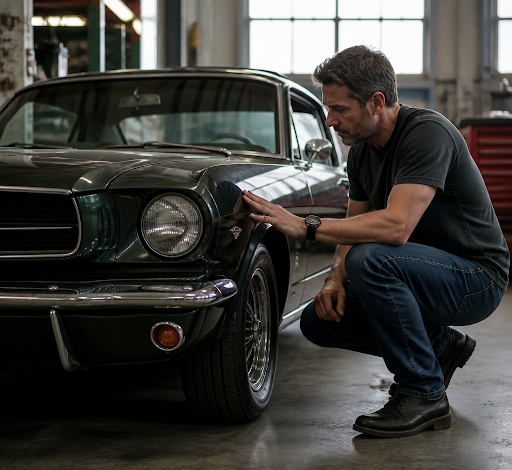
Every classic Mustang advert looks good in the photographs. Low sun, a quiet lane, fresh paint and a pair of chrome bumpers doing most of the selling. The cars that disappoint are rarely the ones that looked bad online — they are the ones where nobody read the small clues. Badge spacing, the shape of a door gap, the colour of overspray inside a wheel arch. Learning to read those details is the single most useful skill a first-time buyer can develop, and it costs nothing but patience.
Why the Mustang Market Punishes Casual Looking
Ford built the first-generation Mustang in enormous numbers, which is why it remains one of the most approachable classics in the world. Parts are available, specialists exist in almost every country, and nothing about the mechanical layout is exotic. The downside of that abundance is that almost any Mustang can be made to look like almost any other Mustang. A base six-cylinder coupe can wear GT stripes, fog lamps, a GT fuel cap and the right wheels by Friday afternoon. None of that is dishonest in itself — plenty of owners simply like the look. It becomes a problem when the price reflects a car that was never built.
So the buyer’s job is not to be suspicious of everyone. It is to separate three different things: what the car was when it left the factory, what has happened to it since, and what it is actually worth in its current state. Those three answers are usually written on the car somewhere, if you know where to look.
Training the Eye Before You Train the Wallet
Spotting detail is a trainable habit rather than a talent. Restorers do it by comparing hundreds of cars until the wrong thing jumps out before they can explain why. Oddly enough, the same mental muscle gets a workout in the online geography puzzles where you study a single frozen frame — kerb design, road markings, a utility pole, the angle of the sun — and reason your way to a location. Anyone who has lost an evening to street-view guessing puzzles already knows the feeling of scanning an image methodically instead of glancing at it. Apply that discipline to a seller’s photo gallery and you will notice things most buyers miss: a shadow line that breaks halfway along a flank, two different shades of black in the engine bay, reflections that bend where a panel has been filled.
A simple photo routine
- Look along the body sides at a shallow angle in every photo that allows it — waves show up in reflections long before they show up head-on.
- Compare left and right panel gaps on the same car, not against your memory of another one.
- Zoom into the areas nobody stages: boot floor corners, inner wings, the lip under the rear valance.
- Ask for pictures taken on an overcast day. Flattering light hides a multitude of ripples.
The Checks That Settle Arguments
Once you are standing in front of the car, work in a fixed order so you do not get distracted by the exhaust note. Start with identity. The VIN on a mid-sixties Mustang tells you the model year, assembly plant, body style and the engine it was built with, and it should agree with the door data plate and the paperwork. Mismatches are not automatically fatal — plates get replaced during restorations — but they change the conversation and should change the price.
Then move to structure. Shock towers, torque boxes, frame rails, floor pans, the cowl under the windscreen and the lower rear quarters are where these cars dissolve. Carry a magnet wrapped in cloth and a torch. Drop the spare wheel out and look at the metal underneath. Press the sill with your thumb. Open and shut the doors with the car on level ground and listen for the hinge sag that signals a tired or badly repaired shell. A rough-running engine is a weekend’s work; a twisted body is a project in disguise.
Mechanical reality
Original drum brakes, recirculating-ball steering and leaf-sprung rear axles are all period-correct and all of them feel exactly as old as they are. Many owners fit front discs, a better master cylinder, improved bushes and a front anti-roll bar, and the car becomes vastly more usable without losing its character. Decide in advance which camp you sit in, because an unmodified survivor and a sorted driver are different purchases with different maintenance bills.
The Rise of the Brand-New Old Mustang
There is now a third route that did not exist for earlier generations of buyers: starting with fresh steel. Licensed reproduction bodies have expanded from fastbacks and coupes into open cars, and coverage of the officially licensed 1967 convertible body shell shows how far the aftermarket has gone in supplying what the scrapyards can no longer provide. For a car that was seriously rotten or crash-damaged, a new shell can be the honest option — and it also explains why some “restored” cars on the market contain far less original metal than the advert implies. Ask what was replaced. A straight answer is a good sign.
When Buying Finished Beats Building
Restoration arithmetic rarely favours the amateur. Bodywork alone can swallow hundreds of hours, and the gap between a tidy ten-foot paint job and a genuinely flat, straight finish is where most budgets quietly die. That is why a growing number of enthusiasts skip the garage years and buy a finished car instead — typically a modern-mechanical restomod with fuel injection, proper brakes, air conditioning and sensible seats, built to a consistent standard rather than assembled from a decade of compromises. Builders such as Revology Cars occupy that space, producing a reimagined classic mustang on new licensed bodywork with contemporary drivetrains, so the romance of 1960s styling arrives with wiring and cooling you can actually trust on a long drive. Whether you go that route or restore your own, studying how those cars are specified is an education in what “done properly” looks like.
Five Steps Before You Hand Over Money
- Write down what you want the car for — shows, weekend roads, long tours — and reject anything that does not suit it, however pretty.
- Decode the VIN and data plate yourself rather than taking the seller’s description on trust.
- Get the car on a ramp. Twenty minutes underneath is worth any number of photographs.
- Drive it properly: brake hard once, turn both ways, listen for clonks at low speed and shimmy at motorway pace.
- Budget a contingency for the first six months of ownership, because every old car reveals its secrets slowly.
The reward for all that squinting is simple. A well-chosen first-generation Mustang is one of the few classics you can use without ceremony — easy to park, easy to fix, instantly recognisable to people who know nothing about cars. Buy the shell and the structure, pay attention to the details nobody bothers to photograph, and the noise takes care of itself.
READ ALSO: Sp5der Hoodie: Ultimate Streetwear Style, Designs, Sizing and Buying Guide