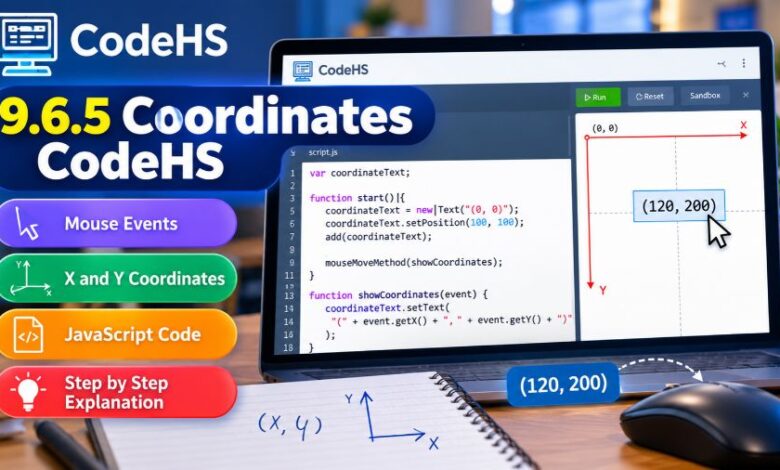
9.6.5 Coordinates CodeHS is a programming topic that helps students understand how coordinates work in a graphics environment and how JavaScript can respond to mouse movement. For beginners learning computer science, this type of exercise provides a practical way to connect programming concepts with visual results. Instead of simply reading about numbers and positions, students can explore how an object or text element interacts with a graphics canvas. Understanding coordinates is an important part of learning graphics programming because many applications use positions to display shapes, move objects, track pointer activity, and create interactive experiences. By learning the basic ideas behind the 9.6.5 Coordinates CodeHS exercise, students can improve their problem-solving skills, understand event-based programming, and become more comfortable writing JavaScript code.
What Is 9.6.5 Coordinates CodeHS?
The 9.6.5 Coordinates CodeHS exercise is associated with learning about coordinates in a programming environment. CodeHS provides educational programming activities that help students practice concepts through hands-on coding. In a coordinates exercise, learners generally explore how positions are represented using horizontal and vertical values. These values help a program identify where something appears on the screen. Depending on the course version, the assignment may also involve mouse movement, displaying coordinate values, or updating text when the pointer changes position. Students should always check their specific instructions because lesson numbering and requirements can vary between courses. The main learning objective is to understand how coordinate information works and how a program can use that information to produce a visible result.
Understanding Coordinates in Computer Programming
Coordinates are numerical values used to describe the position of a point within a defined area. In many two-dimensional graphics environments, a position is represented by an x-coordinate and a y-coordinate. The x-coordinate describes horizontal placement, while the y-coordinate describes vertical placement. Together, these values identify a particular location on the screen. For example, a point represented as (100, 150) has a horizontal coordinate of 100 and a vertical coordinate of 150. When students understand this relationship, they can begin positioning text, drawing shapes, and building simple interactive graphics. Coordinates are also used in game development, animations, website interfaces, and digital design, making this concept useful beyond a single classroom assignment.
How the CodeHS Graphics Canvas Works
A graphics canvas is the area where a program displays visual elements such as text, circles, rectangles, and lines. Every element has a position that determines where it appears within the available space. In a typical CodeHS JavaScript graphics environment, the upper-left corner is commonly treated as the origin, represented by the coordinates (0, 0). Moving to the right increases the x-coordinate, while moving downward increases the y-coordinate. This arrangement differs from the traditional mathematical coordinate plane, where positive y-values usually move upward. Recognizing this difference helps students avoid common positioning mistakes. Once learners understand the canvas layout, they can estimate where an element should appear and adjust its coordinates to create a clear and organized visual result.
The Role of JavaScript in Coordinates Exercises
JavaScript is the programming language used in many CodeHS introductory graphics lessons. It allows students to create visual elements, assign positions, and respond to user actions. A coordinates exercise may use variables to store information, functions to organize instructions, and methods to update what appears on the screen. For example, a program might create a text object and change its displayed content when the mouse moves. Each part has a specific purpose: variables hold references or values, functions define reusable behavior, and methods perform operations on graphics objects. Learning how these elements work together makes programming easier to understand. Rather than treating code as a collection of unfamiliar commands, students can see how each instruction contributes to the program’s overall behavior.
How Mouse Coordinates Work
Mouse coordinates describe the pointer’s position within a particular graphics area or coordinate system. In an event-driven graphics program, the software can detect when the mouse moves and then access position information associated with that event. Some CodeHS environments provide event information through an object that contains methods for retrieving horizontal and vertical coordinates. A handler function can use those values to update text or perform another action. For instance, if the pointer moves to a new location, the displayed coordinate pair can change accordingly. This process demonstrates an important programming principle: a program does not always need to run through a fixed sequence of instructions. It can wait for user interaction and respond when an event occurs.
Example of a Coordinates Program
A simple example can help explain how mouse coordinates might be displayed in a CodeHS JavaScript graphics exercise. The following code illustrates a common approach, although students should adapt it to their assignment’s actual starter code and requirements.
var coordinateText;

function start() {
    coordinateText = new Text("(0, 0)");
    coordinateText.setPosition(100, 100);
    add(coordinateText);

    mouseMoveMethod(showCoordinates);
}

function showCoordinates(event) {
    coordinateText.setText(
        "(" + event.getX() + ", " + event.getY() + ")"
    );
}
In this example, the program creates a text object and initially displays a coordinate pair. It then registers a mouse-movement handler that updates the text whenever the pointer moves. The exact method names and supported features depend on the graphics environment, so this example should not be considered a guaranteed submission for every version of lesson 9.6.5. Understanding the purpose of each instruction is more valuable than copying code without knowing how it works.
Understanding Functions and Event Handlers
Functions help organize a program into manageable sections. In a coordinates activity, an initialization function may create the text object and register an event handler, while another function responds to mouse movement. The initialization function establishes the starting conditions, and the event handler performs an action when the required event occurs. This separation makes the program easier to read, test, and maintain. Students should pay attention to function names, parentheses, braces, and the information passed into each function. If an event handler expects an event object, that object provides access to the information associated with the interaction. Learning this pattern prepares students for more advanced topics, including keyboard controls, button interactions, and animations.
Common Errors in CodeHS Coordinates Exercises
Students can encounter several common problems while completing a coordinates assignment. One frequent mistake is using an incorrect method name or spelling a function differently from the version supported by the environment. Another is attempting to update a text object before creating it, which can cause an error. Missing parentheses, misplaced braces, and incorrect capitalization can also prevent JavaScript code from running. Coordinate confusion is another issue, particularly when students assume that positive y-values move upward on a graphics canvas. To solve these problems, read the error message carefully, review the assignment instructions, and check each function call. Testing small sections of code separately can also make it easier to identify exactly where something goes wrong.
Tips for Completing the Assignment Successfully
The best way to approach the 9.6.5 Coordinates CodeHS exercise is to divide it into smaller tasks. Begin by identifying what the instructions require the program to display or calculate. Next, determine which variables, functions, and graphics methods are needed. If the exercise involves mouse movement, understand how the event handler receives coordinate information before adding extra features. Run the program regularly instead of waiting until every line has been written. This makes mistakes easier to locate and prevents small problems from becoming confusing. Students should also follow any required naming conventions and formatting rules provided by their teacher or course. Most importantly, make sure the final program satisfies the actual assignment rather than relying on a solution intended for a different lesson version.
Why Coordinate Programming Is Useful
Learning coordinates introduces skills that are valuable in many areas of technology. Game developers use positions to move characters, detect interactions, and arrange objects within a scene. Web developers use coordinate-related concepts when creating interactive graphics, maps, and visual interfaces. Animation systems rely on position values to move elements between locations, while design applications use coordinates to place shapes and text accurately. Mouse tracking is especially useful for understanding how software responds to user input. A simple classroom exercise can therefore introduce ideas that appear in much larger applications. As students progress, they can combine coordinates with conditions, loops, variables, and mathematical operations to create increasingly interactive projects.
How to Improve Your JavaScript Problem-Solving Skills
Completing a coordinates exercise is an opportunity to develop a reliable approach to programming problems. Start by translating the written instructions into a list of expected behaviors. Then identify the information the program needs, the actions it must perform, and the conditions under which those actions occur. Write clear code, test the result, and compare the program’s behavior with the requirements. If something does not work, change one part at a time and observe the result. This method helps students understand the cause of an error instead of making random adjustments. Keeping short notes about unfamiliar methods and concepts can also be useful when studying for quizzes or preparing for later programming assignments.
Also read: 9.0.6 Explained: Features, Benefits, and Complete Version Guide
Conclusion
9.6.5 Coordinates CodeHS provides an opportunity to explore the relationship between screen positions, JavaScript, and interactive graphics. By understanding x- and y-coordinates, learning how a graphics canvas is organized, and exploring how event handlers respond to mouse movement, students can build a stronger foundation in programming. Common mistakes involving syntax, function calls, object creation, and coordinate direction become easier to resolve with careful testing and attention to instructions. Although the exact requirements may differ between CodeHS course versions, the underlying concepts remain valuable for beginners. Students who focus on understanding the logic behind their code, rather than simply copying an example, will be better prepared to solve future exercises and develop more advanced interactive applications.